
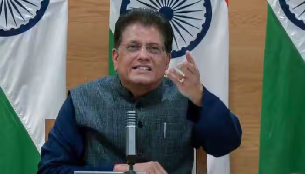

Commerce Minister Piyush Goyal welcomed the India–US interim trade framework, describing it as a major step that would unlock new opportunities for Indian exporters by opening access to the United States, the world’s largest economy valued at nearly USD 30 trillion, with most-favoured-nation (MFN) status.
India and the United States agreed earlier in the day on a framework for an Interim Trade Agreement, which Commerce Minister Goyal said aligns with India’s long-term objective of becoming a developed nation by 2047.
Addressing a press conference, Commerce Minister Goyal said, “Today is a very important day in India’s journey towards a developed India by 2047…With the future in mind, and considering the two countries’ relations, diplomatic ties, and the friendship between their leaders, discussions on a bilateral trade agreement began in February 2025. The objective was to achieve a bilateral trade of $500 billion between India and the United States annually. Today will be written in golden letters for achieving that goal,” he said.
Commerce Minister Goyal said the agreement has generated widespread optimism across the country, with a strong sense of enthusiasm in every sector about future growth prospects.
“There is a wave of happiness throughout the country. There is great enthusiasm in every sector of the country regarding the future. It seems that in the coming days, new opportunities will open up, and the United States of America, the world’s largest economy, an economy of approximately thirty trillion dollars, will now open up to our exporters with most-favoured-nation status,” he said.
Commerce Minister Goyal said under the agreement, the reciprocal tariff on Indian exports to the US will be sharply reduced from 50 percent to 18 percent. He added that this rate is lower than the tariffs faced by India’s neighbouring countries and other competing economies, which is expected to provide a substantial boost to Indian exporters in the coming years.
“Under this agreement, the reciprocal tariff of fifty percent that was levied on Indian exports to the US will now be reduced from fifty percent to just eighteen percent. Eighteen percent is lower than the tariffs imposed by all our neighboring countries and other countries with whom we compete, and this will greatly benefit us and our exporters in the coming days,” he said.
Commerce Minister Goyal further highlighted that several Indian products will now enjoy zero-duty access to the US market. These include gems and diamonds, pharmaceutical products, and smartphones. In the agricultural sector, a wide range of items will also be exported with zero additional duty, such as spices, tea, coffee, coconut and coconut oil, vegetable wax, areca nut, Brazil nut, cashew nut, chestnut, and several fruits and vegetables.
“There are several items on which zero duty will now be levied when our exporters send goods to the United States of America. For example, zero duty will be applied to gems and diamonds. Pharmaceutical products, which are exported from India in large quantities, will also be subject to zero duty. Smartphones, which are exported from India to the US in large numbers, will continue to have zero duty. In this way, there are numerous such items on which zero duty will be levied in the future. In the agricultural sector as well, there are many items that will be exported from India to the US on which a zero reciprocal tariff will be applied, meaning the additional duty will be zero. For example, spices, tea, coffee and products made from them, coconut and coconut oil, vegetable wax, areca nut, Brazil nut, cashew nut, and chestnut. Many fruits and vegetables are also included,” he said.
Commerce Minister Goyal also stressed that the agreement safeguards domestic interests, stating that products in which India has achieved self-reliance have been excluded from the framework. “All those products on which we are ‘aatma nirbhar’ have been kept out of the agreement,” he said.
Commerce Minister Goyal dismissed concerns raised by critics over the interests of Indian farmers, asserting that the deal does not compromise their welfare.
“There are some people in the nation who are against the interests of the farmers. They don’t worry about the farmers’ interests; mislead the public of the nation…They are surprised to see that no steps have been taken in the India-US trade agreement that go against the interests of the farmers of the nation,” he said.
Earlier today, hailing the trade deal, Union Commerce Minister Piyush Goyal said the agreement would open access to a USD 30 trillion market for Indian exporters and generate lakhs of new job opportunities, particularly for women and youth.