
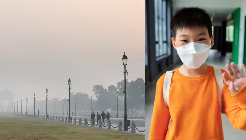

The Delhi government has directed all schools to immediately stop outdoor activities as the city’s air quality deteriorated further into the ‘severe’ category. The decision follows a directive from the Supreme Court, which raised strong concerns about children being exposed to hazardous air conditions.
The order instructs schools across the national capital to suspend all outdoor sports and activities. This comes after the Supreme Court asked the Commission for Air Quality Management (CAQM) to consider issuing instructions to halt sports events scheduled for November and December due to alarming pollution levels.
In its official advisory, the CAQM—Delhi-NCR’s air pollution monitoring and regulatory body—announced that all sports competitions must be postponed. The commission emphasised that the current pollution levels pose serious health risks, especially for children.
The advisory applies not only to schools but also to universities, colleges, and recognised sports associations across Delhi-NCR.
This week, air pollution in Delhi reached dangerously high levels, fluctuating between the ‘very poor’ and ‘severe’ categories. On Friday, the city recorded an average AQI of 373, which experts equate to inhaling the smoke of 10–11 cigarettes a day.
The Delhi government’s decision followed the Supreme Court’s sharp remarks, where the bench suggested shifting sports activities to safer months. The court then directed the CAQM to issue formal instructions to educational institutions.
The amicus curiae assisting the court criticised the timing of outdoor events, stating that allowing children to participate in such activities during November and December was comparable to placing them inside a “gas chamber.”
Earlier in the week, the Delhi High Court also questioned the government’s approach, stating that allowing sports events under such circumstances amounted to “shirking its responsibility.”
Why the Court’s Intervention Matters
Health experts have long warned that children are significantly more susceptible to the harmful effects of polluted air than adults. Their lungs are still developing, they breathe more rapidly, and their smaller bodies absorb a higher concentration of pollutants.
Prolonged exposure to PM2.5 and PM10 has been linked to reduced lung capacity, long-term respiratory issues, asthma, weakened immunity, and even adverse effects on cognitive development.
For thousands of families in Delhi, this crisis is no longer theoretical—it is a yearly struggle marked by constant coughing, increased inhaler use, cancelled playtime, and a spike in paediatric doctor visits. Pulmonologists report that their outpatient numbers rise sharply every November, often by 30–40%.