
China has completed significant upgrades at its Lhunze airbase in Tibet, approximately 40 kilometres north of the McMahon Line, the de facto boundary between India and China in Arunachal Pradesh. Satellite imagery confirms the construction of 36 hardened aircraft shelters, new administrative blocks, and a new apron, enhancing China’s ability to forward-deploy fighter jets and drones near the Indian border.
The Lhunze base, located about 107 kilometres from Tawang in Arunachal Pradesh, now allows the People’s Liberation Army Air Force (PLAAF) to reduce response times for operations against Indian positions in Arunachal Pradesh and Assam.
“Construction of 36 hardened aircraft shelters at Lhunze clearly indicates that during the next incident, their tactical fighters and attack helicopters operating in support of their army would be based in Lhunze,” said Air Chief Marshal (Retd) BS Dhanoa, former Chief of the Indian Air Force, speaking to NDTV. He added that ammunition and fuel would likely already be prepositioned in underground tunnels.
Reflecting on the strategic significance, Dhanoa said, “During the Doklam incident in 2017, I had noted that the PLAAF’s main challenge in Tibet was not aircraft but deployment. I had prophesied that once hardened shelters were built, it would indicate preparations for war, removing a key vulnerability for them in Tibet.”
Air Marshal (Retd) Anil Khosla, former Vice Chief of the IAF, described the upgrades as a “serious strategic threat,” particularly in light of the evolving geopolitical tensions and military infrastructure developments since the 2020 Galwan clashes.
“The upgrades at Lhunze carry profound implications for regional security. The 36 hardened aircraft shelters enable asset dispersal, reduce vulnerability to concentrated attacks, and allow sustained operations in high-altitude conditions,” Khosla said. He further explained that the shelters protect against precision-guided munitions, airstrikes, and missile barrages, making it “far more challenging to degrade the base early in a conflict.”
According to Khosla, airbases such as Tingri, Lhunze, and Burang, located within 50–150 kilometres of the Line of Actual Control (LAC), allow for rapid forward deployment of PLAAF assets and coverage of Indian positions across Arunachal Pradesh, Sikkim, Uttarakhand, and Ladakh.
New satellite images from Vantor (formerly Maxar) also show the presence of CH-4 drones at Lhunze. The CH-4, a high-altitude UAV, can carry short-range air-to-surface missiles and features an electro-optical sensor turret controlled via a datalink.
India plans to counter this threat with the deployment of General Atomics Sky Guardian drones by 2029, with eight drones each for the Indian Air Force and Army. These US-built drones, part of a $3.5 billion deal, will enhance intelligence, surveillance, reconnaissance, and precision strike capabilities across the Himalayas. Currently, Indian forces rely on less capable Israeli-made Heron and Searcher UAVs.
Air Marshal (Retd) SP Dharkar, former Vice Chief of the IAF, said the new infrastructure at Lhunze “will be challenging for India.” He explained that geography and elevation previously gave India some operational advantage, but the expansion of modern airfields and hardened shelters in Tibet is reducing that edge.
Geo-intelligence expert Damien Symon, contributing to The Intel Lab, added, “The rapid construction of these shelters opposite Tawang demonstrates Beijing’s effort to expand air power in a historically sensitive region. While India maintains strong air infrastructure nearby, the scale of militarisation at Lhunze highlights China’s intentions to narrow the gap.”
The Lhunze upgrade is part of a broader Chinese push to strengthen airbases along the Himalayan frontier, including Tingri, Burang, Yutian, and Yarkant. These bases now feature hangars, runway extensions, aprons, engine test pads, and support facilities.
The Indian Air Force, which has reviewed satellite imagery of these developments, stated in April that it “keeps itself aware” of ongoing construction. These upgrades reflect the changing strategic realities along the border, despite efforts to reset ties between New Delhi and Beijing after the 2020 Galwan standoff.
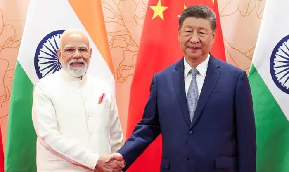
In August 2025, Prime Minister Narendra Modi visited Tianjin for the first time in seven years, meeting Chinese President Xi Jinping. The visit focused on stabilising bilateral relations, expanding trade, renewing direct flights, and cooperation in rare earths, even as both nations continue to modernise military infrastructure along their contested border.