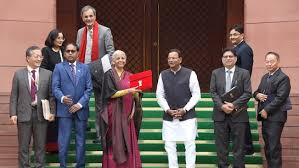

The Union Budget 2026–27, presented by Finance Minister Nirmala Sitharaman on February 1, 2026, sets the financial and policy roadmap for India’s economy in the coming year. It is her ninth consecutive Budget and is positioned as a strategic document aligned with the government’s long-term vision of Viksit Bharat, focusing on sustainable growth, strong public investment, and structural reforms.
Rather than relying on populist measures, Budget 2026 follows a development-first approach, prioritising capital formation, infrastructure creation, national security, rural stability, and economic resilience.
1. Budget Layout and Structure
The Union Budget is divided into two main components: the Revenue Budget and the Capital Budget.
Revenue Budget
This includes the government’s recurring income and expenses. Revenue receipts come from direct taxes (income tax, corporate tax), indirect taxes (GST, customs, excise), and non-tax sources such as dividends and fees. Revenue expenditure includes salaries, pensions, subsidies, interest payments, and running costs of ministries.
This part ensures the daily functioning of the government and welfare commitments.
Capital Budget
The Capital Budget deals with long-term investments and asset creation. It includes spending on infrastructure projects, defence equipment, public sector expansion, and loans to states. Capital receipts include borrowings and disinvestment proceeds.
In Budget 2026, capital expenditure has reached a record level, reinforcing the government’s commitment to infrastructure-led growth.
2. Overall Fiscal Picture
For 2026–27, total government expenditure is estimated at Rs 53.4 lakh crore, with capital expenditure alone accounting for over Rs 12.2 lakh crore. Effective capital spending, including grants to states for asset creation, is estimated at over Rs 17 lakh crore.
This indicates a clear shift from consumption-based welfare spending to productive investment-based governance.
The fiscal deficit remains under control, showing the government’s continued focus on fiscal discipline while supporting economic expansion.
3. Expenditure Priorities: Where the Money Goes
The sector-wise expenditure data from the official Budget document reveals the government’s real priorities.
Major Allocations (Rs crore)
Transport – Rs 5,98,520
Defence – Rs 5,94,585
Rural Development – Rs 2,73,108
Home Affairs – Rs 2,55,234
Agriculture & Allied Activities – Rs 1,62,671
Education – Rs 1,39,289
Energy – Rs 1,09,029
Health – Rs 1,04,599
Urban Development – Rs 85,522
IT & Telecom – Rs 74,560
Commerce & Industry – Rs 70,296
Social Welfare – Rs 62,362
Scientific Departments – Rs 55,756
Tax Administration – Rs 45,500
External Affairs – Rs 22,119
Finance – Rs 20,649
Development of North East – Rs 6,812
4. Infrastructure-Led Growth Strategy
Transport is the single largest expenditure head, covering highways, railways, metro networks, ports and airports. This confirms that Budget 2026 is fundamentally built around infrastructure as the main growth engine.
The idea is simple: infrastructure investment creates jobs, reduces logistics costs, boosts private investment, and strengthens national productivity.
This strategy positions the government as a nation builder, not just a welfare distributor.
5. Security and Strategic Spending
Defence spending is almost equal to transport, showing that national security remains a top priority. This includes military modernisation, indigenous defence manufacturing, border infrastructure, and cyber defence systems.
Home Affairs spending further strengthens internal security, disaster management, and policing capacity.
Together, these allocations underline India’s focus on strategic stability in an uncertain global environment.
6. Rural and Agricultural Support
Rural Development and Agriculture together account for more than Rs 4.3 lakh crore. This covers rural employment schemes, housing, irrigation, drinking water, farmer support programmes and allied activities.
Despite the urban and industrial focus, the government continues to prioritise rural income stability and political-economic balance.
7. Education and Health
Education and Health together receive over Rs 2.4 lakh crore, funding schools, universities, hospitals, health insurance schemes and medical infrastructure.
While this is substantial, it is still much lower than defence or transport, showing that human development is important but not the central driver of this budget.
8. Technology, Science and Innovation
IT, Telecom and Scientific Departments receive strong allocations aimed at:
Digital governance
Cyber infrastructure
Space research
Atomic energy
R&D institutions
These are long-term strategic investments designed to prepare India for a technology-driven future economy.
9. Tax Policy and Reforms
Budget 2026 does not change income tax slabs but introduces several targeted reforms:
Lower TCS rates for overseas travel, education and medical remittances
Dividend deduction mechanisms for investors
Extended ITR revision deadlines
Automated tax compliance systems
The approach is not about cutting rates but about reducing friction and improving cash flow efficiency.
10. Manufacturing and Industrial Strategy
The Budget places strong emphasis on domestic manufacturing through:
Special incentives for electronics, semiconductors, chemicals and textiles
Biopharma and rare-earth processing initiatives
National fibre schemes and industrial parks
This reflects India’s ambition to become a global manufacturing hub, reducing import dependence and increasing export competitiveness.
11. Structural and Governance Reforms
The BH1 document highlights more than 350 structural reforms, including:
GST simplification
Labour code implementation
Regulatory streamlining
Digital public infrastructure
Foreign exchange management review
These reforms aim to create a trust-based, low-friction economic system.
Final Interpretation
Union Budget 2026–27 is a hard infrastructure, security and productivity budget.
It is not designed to win short-term political applause but to build:
Roads, railways and cities
Defence power
Manufacturing capacity
Technological leadership
Economic resilience
In essence, Budget 2026 represents a state-capitalist development model, where the government acts as the primary builder of national capacity and private enterprise is expected to follow.