
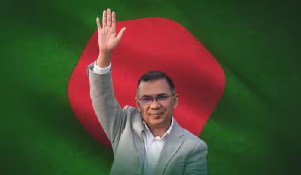

A new dawn in Bangladesh’s politics unfolded on Tuesday as BNP chief Tarique Rahman took oath as Prime Minister of the nation. Rahman, the son of former prime minister Khaleda Zia, led his party to a landslide victory in the general elections after returning from 17 years in exile.
In the February 12 elections, the Bangladesh Nationalist Party (BNP) secured a commanding majority in the 300-seat parliament, winning more than 151 seats.
On the other hand, Jamaat-e-Islami, previously an ally of the BNP, contested as a rival and emerged as the second-largest party, establishing itself as a key opposition force.
India-Bangladesh ties
Lok Sabha Speaker Om Birla represented India at the swearing-in ceremony of the newly elected government of Bangladesh.
Upon his arrival, Birla was welcomed by Bangladesh’s Foreign Ministry Secretary, Nazrul Islam. The Lok Sabha Speaker described the occasion as an “important moment” that would deepen people-to-people connections and reinforce the shared democratic values of India and Bangladesh.
An invitation had also been extended to Prime Minister Narendra Modi, who was among the first world leaders to congratulate Rahman on his victory. However, Modi was scheduled to hold talks with French President Emmanuel Macron in Mumbai on Tuesday.
Meanwhile, Bangladesh’s interim government leader, Muhammad Yunus, resigned on Monday. The caretaker administration had been governing the country following the removal of Sheikh Hasina in July 2024.
In his farewell address to the nation before handing over power to an elected government, Yunus said, “Today, the interim government is stepping down. But the practice of democracy, freedom of speech, and fundamental rights that has begun must not be allowed to falter.”
The Speaker’s participation at this important event underscores the deep and enduring friendship between the peoples of India and Bangladesh, reaffirming India’s steadfast commitment to the democratic values that bind the two nations, a statement of the Ministry of External Affairs (MEA) read.
Bangladesh’s future
His swearing-in signals the beginning of a new political phase for Bangladesh under a fresh administration. The transition marks the return of the BNP to power after years in opposition, raising expectations of policy shifts and a recalibration of governance priorities.
With a landslide victory in the elections, the new government has been entrusted by the people to steer the nation through a range of challenges. It remains to be seen what tone Tarique Rahman will set for Dhaka’s domestic and foreign policy.