

Harsh V. Pant Atul Kumar
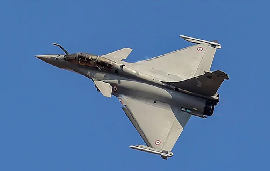
In November 2025, the US-China Economic and Security Review Commission (USCC) reported that Beijing coordinated a disinformation campaign against France’s Rafale fighter after India used the jets in strikes against Pakistan. Chinese operatives used AI-generated images and video game clips, presenting them as debris to claim that Pakistan’s Chinese-supplied J-10s had shot down Indian Rafales. Therefore, Beijing sought to position its J-10 and J-35 fighters as superior to French, Russian or Indian combat aircraft.
The effort partially succeeded. One of the potential buyers, Indonesia, proceeded with a purchase of 42 J-10s in October 2025, at approximately USD9 billion. The episode now raises broader questions: how and why is China aggressively promoting its weapon platforms? Was this an isolated push, or part of a longer pattern in how Beijing markets its weapons? How has China performed so far in the international arms export market?
Modus Operandi, Expected Benefits
As observed in the Rafale episode, Beijing’s modus operandi is as follows: it starts by circulating fabricated or misleading images online, seeding a narrative crafted to shape early impressions. Then, Chinese state media and friendly outlets pick up the thread, amplifying the storyline and giving it official credibility. In the final step, Chinese embassies, diplomats and defence attachés quietly press the case with potential buyers, pointing to the fabricated account as proof of how Chinese weapons supposedly performed in the latest conflict.
The expected benefits are extensive. The global market for major weapons buyers is limited, and even marginal gains can bring outsized returns, both in revenue and in long-term strategic leverage. Selling advanced weapons locks customers into years of spare-parts contracts, training and maintenance, giving Beijing a durable influence while pushing back Western presence in those regions. Moreover, by shaping the narrative against Western systems, China sows doubt among potential buyers and, crucially, reassures its core clients, Pakistan, Bangladesh, Myanmar, among others.
Third-Tier Arms Exporter
Nevertheless, China is still widely seen as a third-tier arms exporter, a discount supplier overshadowed by Western and Russian defence industries. Beijing’s military-industrial base originally grew by imitating and reverse-engineering Soviet systems. Once the Soviet advisers left after the Sino-Soviet split in 1960, China spent decades confined to selling small arms, light equipment, and other low-tech weapons to friendly states, mostly as grants-in-aid.
The landscape shifted in the 1980s as Middle Eastern conflicts opened major markets for Beijing’s heavy weapons. However, the end of the Cold War, followed by a surge in global competition, sharply eroded China’s market share. The first Gulf War dealt a further blow: the poor battlefield showing of Soviet-designed systems damaged Moscow’s reputation and hit China’s imitations even harder. In addition, Beijing’s reputation as a low-tech weapon supplier, its recurring performance problems and chronic spare-parts shortages consistently dragged down its appeal.
Nevertheless, since 2000, Beijing has carved out a niche by targeting a tight circle of clients. As of 2023, China’s share stands at about 5% of global arms exports, compared with 40% for the US and 16% for Russia. Moreover, roughly 60% of China’s sales, especially of aircraft, missiles, armoured vehicles, and naval ships with co-production deals, go to Pakistan, Bangladesh and Myanmar. Beyond this core, customers such as Algeria, Egypt, the UAE and others have purchased Chinese drones and directed-energy systems, often with mixed or disappointing results. For many of these states, China remains a fallback option where bargain prices and opaque contracts can open the door to corruption among military elites.
Low Reputation: Aggressive Marketing
However, China’s effort to move up the arms-export ladder continues to run into structural barriers. Persistent technical, performance and sustainment failures, from Myanmar’s JF-17s to Pakistan’s air-defence systems and naval platforms, undermine confidence and highlight the hidden costs of supposedly low-priced equipment. The result is a widening gap between polished marketing and lacklustre field performance, forcing clients to diversify suppliers or demand stricter warranty and maintenance terms. Beijing also struggles to enter the top tier in sensor fusion, logistics and other advanced technologies, where Western manufacturers still command a decisive lead.
Therefore, Beijing has leaned on a familiar toolkit: aggressive pricing, technology-transfer sweeteners, diplomatic pressure and perception-shaping information campaigns. These tactics deliver incremental gains and deepen leverage over dependent clients; however, they lose traction in markets where performance and transparency matter. Moreover, as new suppliers such as India, Turkey, South Korea, among others, push into the global arms trade with better technology and reputation, even holding a third-tier position will become noticeably harder for China in the years ahead.