
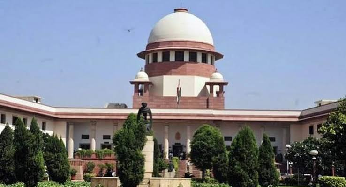

The Supreme Court is examining a question that could reshape how English is viewed under the CBSE’s implementation of India’s school language policy: Can a language deeply embedded in Indian society be treated as “non-native” or “non-indigenous” for the purposes of the three-language formula?
The issue has come under judicial scrutiny as CBSE prepares to implement the policy for the 2026–27 academic year. The bench has also raised concerns about teacher shortages, inadequate learning materials and infrastructure, and the additional pressure that the policy could place on students.
Why is the Supreme Court debating English?
The dispute concerns CBSE’s implementation of the three-language formula under the National Education Policy and the National Curriculum Framework. Under the relevant CBSE framework, students are required to study three languages, with at least two of them being Indian languages, described in the policy as “native Indian languages” or Bhartiya Bhashas.
The petitioners argue that treating English as a non-native or foreign language could impose additional requirements on students who study English alongside Indian languages. They have also raised concerns about the burden of implementing the policy where schools lack adequately trained teachers and learning resources.
The Supreme Court is examining whether classifying English in this manner is legally and constitutionally appropriate. It has not yet ruled that English is an indigenous Indian language or declared the CBSE policy unconstitutional.
The constitutional question over English
A three-judge bench headed by Chief Justice Surya Kant, with Justices Joymalya Bagchi and V. Mohana, has questioned the use of the terms “non-native”, “non-indigenous” and “foreign” in relation to English.
Justice Joymalya Bagchi specifically questioned the word “native” and its colonial associations. The court also referred to English’s long history in India and its deep integration into the country’s institutional and social life.
The central question is whether English can be treated simply as a foreign or non-indigenous language for this education policy when it has been used in India for centuries and plays an important role in the legal, administrative, educational and professional spheres.
What does the three-language policy say?
The relevant CBSE framework requires students to study three languages. At least two of the three must be Indian languages.
The NEP broadly encourages education in a child’s mother tongue or regional language, particularly during the early years, where practicable. However, this recommendation should not be understood as a universal legal requirement that every child must begin schooling in their mother tongue.
Under the CBSE framework under challenge, a foreign language may generally be taken as the third language only after the required Indian-language conditions are met or as an additional language. This is why the classification of English matters. If English is treated as foreign or non-indigenous, students and schools could face requirements different from those applicable to students studying Indian languages.
The litigation primarily concerns CBSE’s implementation of the policy, rather than a direct challenge to every version of the three-language approach followed by all schools and states across India.
What is the Centre and CBSE’s position?
Additional Solicitor General Aishwarya Bhati told the court that English has official status for specified Union purposes under the Constitution and related legal provisions. She argued that this status and English’s established role in India cannot simply be disregarded.
At the same time, the Centre and CBSE maintain that English should not be treated as an indigenous Indian language under the language policy. The government’s position distinguishes between English’s official and widespread use in India and its historical origin outside India. Bhati explained the distinction by saying that “language is the vehicle of a culture.”
English is not included in the Eighth Schedule of the Constitution, although it has official status for specified purposes and is widely used in courts, administration, education and public life. The Supreme Court is considering how these facts should affect English’s classification under the CBSE framework.
Why did the court question the word “native”?
Justice Joymalya Bagchi questioned whether the word “native” is suitable for determining which languages qualify as indigenous. The observation is significant because the term has colonial associations and may be difficult to apply in a linguistically diverse country such as India.
The bench is also considering English’s historical place in India. Its long use in Indian institutions and society has raised the question of whether it should be placed in the same category as a foreign language newly introduced into the country.
This does not mean that the court has already recognised English as an indigenous Indian language. It means that the constitutional and policy implications of describing English as non-native or non-indigenous require further examination.
Why does the English debate matter?
The dispute is not only about whether students should learn English. It raises a broader question about how India should classify languages that originated outside the subcontinent but have been used in the country for a long period and have become deeply embedded in its institutions and society.
The Supreme Court is examining the issue alongside questions concerning the Constitution, Indian languages, education policy and school readiness. The practical availability of trained teachers, textbooks, learning materials and infrastructure could significantly affect how the policy operates on the ground.
The proceedings have also included discussion of possible transitional relief for students, including students in Class VI, while the broader policy and implementation issues are reconsidered.
The key question before the Supreme Court
At the heart of the case is this question: Can English, given its long history and established place in Indian society, be treated as a foreign or non-indigenous language under CBSE’s three-language framework, and can that classification be applied without violating constitutional or educational principles?
The Supreme Court has raised this question but has not yet delivered a final judgment.