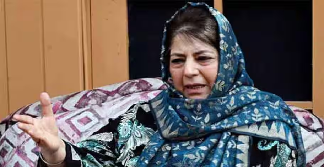

PDP president and former Jammu and Kashmir Chief Minister Mehbooba Mufti declared herself a “Dimaagi Naxal,” stating that she supports Article 370 of the Constitution. Her post on X came in direct response to Union Parliamentary Affairs Minister Kiren Rijiju, who had listed supporters of Article 370 among those who could be described by the term used by Prime Minister Narendra Modi.
Quoting Rijiju’s post, Mufti wrote: “I support Article 370. I’m a ‘Dimagi Naxal.’” The exchange forms part of the political fallout from Modi’s Independence Day address at the Red Fort on August 15, in which he warned that while armed Naxalism had largely been eliminated from the forests, “Dimagi Naxals” remained embedded in the system and needed to be identified and isolated.
Rijiju clarified that the Prime Minister “didn’t call opposition leaders ‘Dimagi Naxals.'” Instead, he listed categories that, in his view, fit the description: those who support Maoists and reject the Indian Constitution, those who stand with separatists and support Article 370, and those who want to cut the “Chicken’s Neck” (Siliguri Corridor) to separate the North-East from India.
Mehbooba Mufti’s response was pointed. By openly reaffirming her long-standing demand for the restoration of Article 370—which granted special status to Jammu and Kashmir until its abrogation in August 2019—she placed herself squarely in one of the categories Rijiju had named. The restoration of Article 370 remains a core political demand of the PDP and several other regional parties.
The episode reflects the sharp polarization over the “Dimagi Naxal” label. While the government frames it as a warning against ideological extremism that rejects constitutional authority or supports separatism, opposition voices view the term as an attempt to stigmatize dissent. Other leaders, including Congress’s P. Chidambaram, had earlier responded by saying they were “proud” to be called one. Mufti’s post added a specifically Kashmir-focused dimension to the national debate.
The exchange underscores how the phrase coined in the Prime Minister’s speech has quickly become a political flashpoint, with parties using it to draw lines over issues ranging from Left-wing extremism to the constitutional status of Jammu and Kashmir.