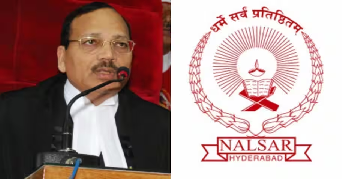

The Supreme Court questioned the Bar Council of India (BCI) over its decision to act against students of the National Academy of Legal Studies and Research (NALSAR) University of Law, Hyderabad, who had protested against the proposed invitation to Chief Justice of India Surya Kant as chief guest at the university’s convocation.
A bench led by CJI Surya Kant issued notice to the BCI on a plea filed by NALSAR challenging two circulars issued by the legal regulator. The court agreed to hear the matter after it was mentioned by Senior Advocate K. Parameshwar.
During the hearing, CJI Surya Kant said the BCI had no role in interfering with students who were exercising their right to protest lawfully.
“BCI has nothing to do with this. We are with you. Students have written a letter to me. It’s a dialogue between students and me. Who are they to unnecessarily issue a circular?” the CJI said.
Recalling his own college days, he added, “When I was in college, I was actively involved in student activities. Sometimes, even if they are saying the wrong thing, if they are lawfully raising their voice, it must be allowed.”
The Supreme Court’s intervention came after the BCI initially directed all State Bar Councils not to enrol any NALSAR student who graduated in 2026 until its inquiry into the protest was completed.
In a letter to the State Bar Councils, BCI Chairman Manan Kumar Mishra had said, “Till further orders, no student of NALSAR University of Law, who obtained the Law Degree in the year 2026, shall be enrolled by any State Bar Council as an Advocate.”
The BCI had also said that a law student who showed “no regard or respect for the highest Judicial Office of the country” could not be expected to become a responsible advocate, teacher or judge.
BCI sought details of NALSAR protest organisers
The BCI had sought a factual report from NALSAR on those who allegedly initiated, organised or mobilised the campaign against the CJI’s participation in the convocation. The date of the convocation has not yet been finalised.
The regulator asked the university to clarify whether permission had been sought or granted for any protest or organised activity, and whether any university rules relating to student conduct, discipline or the use of university platforms had been invoked.
It also asked whether any of the alleged organisers were already enrolled as advocates with a State Bar Council and, if so, sought details of their enrolment.
The BCI said legal education necessarily encourages “critical reasoning, debate and analysis of judicial decisions”, but argued that students seeking entry into the legal profession must understand the distinction between reasoned criticism and conduct that could undermine the dignity and ethical standards of the profession.
The regulator further asked NALSAR to identify office-bearers of student bodies who had participated in initiating, approving, coordinating or circulating the campaign.
It also sought details of any faculty member, research scholar, alumnus or outsider who may have helped initiate, draft, coordinate, advise or facilitate the campaign.
Over 400 students opposed CJI’s invitation
More than 400 students, including graduates from previous years, had opposed the proposal to invite CJI Surya Kant as chief guest at the convocation.
The students’ objections were linked to remarks made by the CJI during the hearing of a petition concerning alleged police excesses against student protesters at Jantar Mantar in Delhi last month.
The BCI’s initial action drew considerable criticism, particularly because it affected the enrolment of an entire graduating batch.
BCI later modifies order
Later on Thursday, the BCI modified its earlier directive and cleared the way for all 2026 NALSAR graduates to enrol with the State Bar Council of their choice.
In a fresh letter, Mishra said that after “thorough discussion and deliberation”, the Council had unanimously concluded that the vast majority of the graduating students were innocent and had not intended to participate in the alleged “move of disrespect”.
The BCI said it had received information suggesting that a small number of teachers and outsiders may have been instrumental in instigating the students.
The Council said it would await the factual inquiry report from NALSAR Vice-Chancellor Srikrishna Deva Rao before deciding on any further action.
Emphasising the need to protect students who were not at fault, the BCI said: “No student shall be made to suffer without any fault on his part.”
Mishra, who is also a Senior Advocate and Rajya Sabha MP, confirmed the revised decision in a post on X. He said the inquiry would continue and any further action would depend on its findings.
The revised order provides immediate relief to the 2026 graduating batch, allowing students to proceed with enrolment while the dispute over the protest and the BCI’s earlier action remains before the Supreme Court.