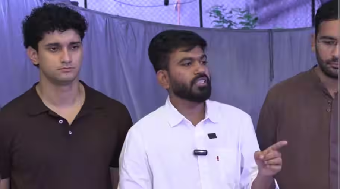

Cockroach Janta Party (CJP) founder Abhijeet Dipke on Thursday launched a nationwide public outreach campaign, ‘Kya Bolti Public ‘, saying the initiative is aimed at understanding the concerns of ordinary people across the country. Speaking at a press conference after the party’s core team meeting in his hometown of Chhatrapati Sambhajinagar, Maharashtra, Dipke said education reform would be the campaign’s priority, arguing that rising school, college and coaching fees have made quality education increasingly unaffordable.
The CJP’s core team had been meeting at Dipke’s residence since Wednesday before concluding its discussions on Thursday.
“Education reform will be the first issue that we are going to take up. We believe education has become unaffordable in the country. Annual fees are in the range of ₹1 lakh to ₹2 lakh for Class 1, over and above the donation money,” Dipke said, according to the Hindustan Times report.
Questioning how low- and middle-income families manage such expenses, he added, “From where the families bring the money who do not have that much income.”
Dipke said soaring college and coaching fees were forcing many families into debt and pledged to work towards reducing that financial burden.
“College fees and coaching fees are also becoming too high, bringing families into the burden of loans. We want to free families from this. The parents should not feel burdened if they want to give higher education to their children,” he said.
Citing Dr B R Ambedkar, Dipke argued that education should remain a right rather than a commercial enterprise.
“It is a fundamental right, according to Dr BR Ambedkar, but in the last few years, it has turned as education is a fundamental business to gain business,” he said.
Referring to the party’s recent protest at Jantar Mantar, Dipke said the public response reflected wider dissatisfaction with the political system, extending beyond concerns over NEET or the education sector.
“The response to the Jantar Mantar protest was not limited to NEET or for the education system per se. It was against the entire system created in the last few years,” he said.
He alleged that people were losing faith in democratic institutions, claiming that elected representatives often switched political parties after winning elections.
Dipke also questioned the neutrality of the judiciary, alleging that rulings increasingly favoured the ruling party while ordinary citizens faced long delays in securing hearings.
“The judicial decisions are coming and have created questions about their neutrality. The way more decisions come in the favour of ruling parties, a common man does not get early hearing, he continues to get dates. In contrast, when a big businessman approaches court, he gets urgent hearing and quick verdict,” he said.
He further claimed that courts acted swiftly in political matters but were slow to deliver justice in cases involving ordinary citizens.
“The court immediately gives a verdict on splitting parties and induction of MLAs from one party to another, but the same court does not have time when the common man wants justice. This has created a big question on the integrity and neutrality of the courts,” he said.