
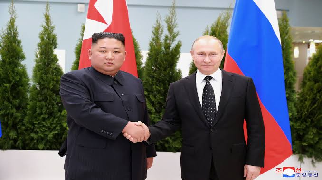

North Korea has reportedly expanded its military support for Russia by deploying a missile unit in western Russia, a move that could increase attacks on Ukraine. According to a Ukrainian military intelligence official, the North Korean unit has begun its deployment and may be equipped with around 120 ballistic missiles and six launchers.
Andriy Chernyak, an official with Ukraine’s Main Intelligence Directorate (HUR), said Russia plans to place around 90 North Korean military personnel under its 112th Missile Brigade in the Voronezh region of western Russia. The deployment is expected to strengthen Russia’s missile capabilities as the war with Ukraine continues.
Ukraine’s intelligence agency also claimed that North Korea has already sent a fresh batch of around 40 KN-23 and KN-24 ballistic missiles, along with military personnel, to Russia. However, the final structure of the deployment and the total number of missiles are expected to be decided during high-level talks between the two countries next month. Russia reportedly hopes to deploy up to 120 North Korean ballistic missiles and six launchers.
How could this deployment affect the Ukraine war?
The development comes at a time when Ukraine is facing a serious shortage of advanced air defence systems. Ballistic missiles are considered difficult to intercept, making them one of Russia’s most effective weapons. Military experts believe Moscow is trying to exploit this weakness by increasing the use of ballistic missiles against Ukrainian targets.
Since late 2023, Russia has launched dozens of North Korean-made ballistic missiles at Ukraine. The reported deployment of North Korean missile forces marks another step in the growing military cooperation between Moscow and Pyongyang.
Why are North Korean ballistic missiles a major concern?
Last week, Russia reportedly fired two North Korean missiles at Ukraine for the first time since August. One of the strikes destroyed a residential house in the village of Radushne in central Ukraine, killing at least five members of the same family.
Experts warn that Ukraine’s limited ballistic missile defence remains one of its biggest vulnerabilities. If Russia receives more North Korean missiles, the threat could grow significantly, especially during the winter months when Moscow is expected to target Ukraine’s power infrastructure and electricity grid.