
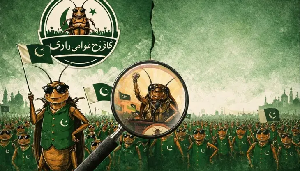

After India’s viral Cockroach Janta Party (CJP) movement, a similar group calling itself the Cockroach Party Pakistan (CPP) has emerged on social media. The group says it aims to fight corruption, poor governance and Pakistan’s growing economic challenges while representing the concerns of young people and ordinary citizens.
According to the group, its agenda focuses on strengthening economic and political stability, improving education, addressing the country’s energy crisis and tackling water scarcity. On Instagram, the account has gained more than 112,000 followers. The group also claims that Pakistan belongs to its people and not to what it describes as ‘corrupt mafias,’ positioning itself as a voice for the country’s youth.
Growing online presence
Information available on the group’s Instagram page shows that the account was created in May and is operated from Canada. It received verification in early July.
Manifesto focuses on governance and reforms
In its recently released manifesto, the Cockroach Party Pakistan says it represents ordinary Pakistanis, especially young people, who are frustrated with corruption, dynastic politics and a system based on privilege.
The manifesto promises greater transparency, accountability and democratic reforms. It also highlights creating employment opportunities, improving the education system, strengthening governance and finding long-term solutions to Pakistan’s energy crisis and water shortage.
Key promises made by the group
The manifesto outlines several priorities, including action against corruption, opposition to nepotism and privilege-based politics, creating more jobs, improving education, addressing the country’s energy and water challenges, and ensuring long-term economic and political stability.
Questions remain over public support
Despite its growing popularity on social media, it remains unclear how much public backing the movement has beyond the internet. Questions also remain about its organisational strength and whether it can transform its online following into a meaningful political movement.
Critics of Pakistan’s military-political establishment argue that repeated military involvement in civilian affairs has weakened democratic institutions and reduced accountability. They accuse Army Chief Asim Munir, Prime Minister Shehbaz Sharif and the wider civil-military establishment of failing to address inflation, unemployment, governance issues and corruption while allowing political and institutional power to remain concentrated among a limited group of influential figures.
How did the ‘Cockroach Party’ movement begin?
The emergence of Cockroach-themed political groups in both India and Pakistan traces back to remarks made by the Chief Justice of India, who referred to some unemployed young people involved in activism as ‘cockroaches’ and ‘parasites.’
Following those comments, the Cockroach Janta Party (CJP) was formed in India as a satirical protest movement. Its popularity later inspired similar groups in Pakistan, including the Cockroach Awami Party and the Cockroach Awami League, which appeared on social media around May 2026.
These groups describe themselves as the voice of unemployed youth, ‘lazy’ youngsters and Generation Z, while challenging established political narratives online.
Pakistan’s Interior Minister Mohsin Naqvi also referred to the impact of India’s CJP, warning that frustrated young people who had been dismissed as ‘cockroaches’ could bring about significant political change if they united.