
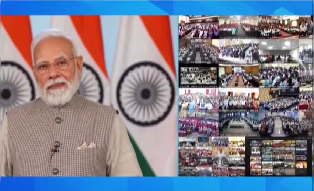

Prime Minister Narendra Modi on Sunday said India’s young people are “aware, socially conscious, and serious about their duties” as he launched the Nasha Mukt Yuva for Viksit Bharat Sankalp Abhiyaan, a nationwide campaign aimed at encouraging youth to lead the fight against substance abuse.
Launching the initiative through video conferencing, the Prime Minister said a healthy and drug-free young population was essential for achieving the vision of Viksit Bharat by 2047.
“We are gathered here for a great and important resolution. This initiative is for an individual, family, society and, most importantly, for the country,” PM Modi said.
“When the country is moving forward towards the resolution of Viksit Bharat, then the country’s youth must be mentally and physically healthy and away from the problem of drugs. Hence, we have to make a resolution that the country’s youth is aware and away from the problems of drugs,” he added.
The campaign marks the beginning of a 100-week nationwide Jan Bhagidari (people’s participation) movement led by MY Bharat volunteers. Weekly activities will be held every Sunday across the country to raise awareness about the dangers of drug abuse and encourage public participation in building a drug-free society.
The programme will include sports events, walkathons, meditation sessions, cultural programmes, awareness drives, street plays, discussion forums, art competitions and community outreach activities.
Recalling that the initiative began as a pilot project in Kashi last year, the Prime Minister said the campaign had grown with the support of spiritual organisations across the country.
“As an MP from Kashi, I am happy that last year this project was launched from the holy land of Kashi as a pilot project. Therefore, in addition to scientific clarity, it also possesses spiritual energy, the blessings of saints, and cultural heritage,” he said.
PM Modi noted that 125 spiritual organisations have adopted the Kashi Declaration, a five-year roadmap for a drug-free India that was adopted at the Youth Spiritual Summit in Varanasi in July 2025.
He praised the participation of young people from different backgrounds, saying, “All of you have strengthened my belief that the youth of India is aware, socially conscious, and serious about their duties.”
Describing young Indians as the country’s “Amrit Peedhi”, the Prime Minister said they would shape the nation’s future over the next two decades.
“In the next 20-25 years, you will give direction to your lives. You will be the ones who will take India towards the resolution of Viksit Bharat, and you will be the ones enjoying the fruits of that achievement. The country needs your energy, creative imagination and talent. Hence, for the country and your own lives, keep yourselves away from drugs,” he said.
Highlighting the strength of collective action, PM Modi said social campaigns become more effective when people work together.
“There are some tasks that, when undertaken individually, can sometimes lead to frustration. But when they turn into a collective campaign, and millions of people march shoulder to shoulder, even those who couldn’t manage them on their own find themselves infused with a surge of energy. Today, this campaign, driven by that very strength, is touching every young heart,” he said.
The initiative seeks to bring together educational institutions, youth organisations, civil society groups, industry bodies and spiritual organisations to strengthen the nationwide movement against substance abuse.
The programme saw participation from young people at more than 10,000 locations across India, including MY Bharat volunteers, National Service Scheme volunteers, youth clubs, schools, colleges, universities, non-governmental organisations and youth wings of industry associations.
The campaign is part of the government’s broader vision of a Nasha Mukt Bharat and aims to encourage young people to become ambassadors of positive social change. Its central message is that a drug-free youth population is the strongest foundation for a developed India by 2047.
(With agencies’ inputs)