
Naghma Sahar
“India mein kaha jaata hai, ‘Dar ke aage jeet hai’. Pakistan mein shayad kahani kuch aur hai: ‘Ghar ke aage jeep hai’.”
(In India, it’s said, ‘There’s victory beyond fear’. Pakistan’s story is different: ‘There’s a jeep in front of the house.'”)
A young Pakistani woman’s video on X captures, in a chilling sentence, the dark crisis unfolding in her country. The slightest dissent is crushed by security forces. Protesters simply disappear. The Balochs have paid the price of dissent with the disappearance of their young men. Prominent human rights activist Dr Mahrang Baloch, who spearheaded massive peaceful anti-disappearance marches across the country, was recently convicted by an anti-terrorism court in Quetta and sentenced to life imprisonment.
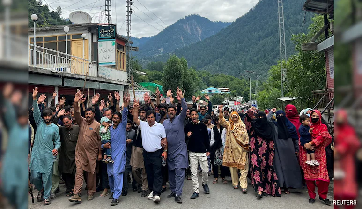
While the world watches the political turmoil in Pakistan-occupied Kashmir (PoK) from a distance, Pakistan’s own citizens are confronting something far more immediate: the power of the state on their streets. The images emerging from PoK are difficult to ignore: streets stained with blood, protesters lying motionless, grieving families searching for loved ones, and heavily armed security personnel confronting civilians. They present a picture sharply at odds with Pakistan’s longstanding claim on international platforms – that it is the defender of the democratic aspirations of the people of Jammu & Kashmir.
The scale of the violence may be contested, but there is little doubt that the crackdown has been severe.
At the heart of the unrest is a political and democratic question. The Joint Awami Action Committee (JAAC), a prominent civil-society coalition leading the agitation, was banned by the authorities under anti-terrorism laws. The protests have continued for weeks, driven by grievances over political representation, governance, and the credibility of the electoral process. The elections themselves have been marred by allegations of rigging, boycotts, and violence. The most popular mass leader, Imran Khan, continues to be in jail, and his party, the Pakistan Tehreek-e-Insaaf (PTI), has boycotted the elections.
But the larger question goes beyond the elections.
Can Pakistan’s citizens protest without being treated as enemies of the state? And after Balochistan, can Pakistan afford to see another region slip into sustained unrest?
The Pakistani youth is voicing another uncomfortable question: while the Pakistani television channels gleefully flashed visuals of the recent youth protests in India, the protests and the coverage of the bloodshed in Mirpur and Rawalakot were completely blacked out.
The contrast has not gone unnoticed.
When young people in India took to the streets over issues such as paper leaks, their protests became a major subject of public debate. In Pakistan, however, young people confronting what they describe as state high-handedness are facing bullets, arrests, and the branding of their civil-society movement as a security threat.
And then came an extraordinary statement from Pakistan’s Defence Minister Khawaja Asif. Defending the state’s response to the protesters, Asif said he viewed the protesters in Pakistan-administered Kashmir “the same way” he viewed India: enemies. His remarks have triggered further outrage because they expose the central contradiction at the heart of the crisis: what happens when a state begins to see its own protesting citizens through the lens of an external enemy?
The violence in PoK is thus not merely about an election. It is about the shrinking space for dissent. If citizens demanding their rights are treated as enemies, then who, exactly, is the state supposed to protect?
What is unfolding in PoK did not happen overnight. The unrest has been building over political grievances, particularly the Pakistani government’s decision to reserve 12 seats in the Azad Jammu and Kashmir Legislative Assembly for refugees who migrated from Jammu and Kashmir decades ago. The Joint Awami Action Committee (JAAC), an alliance of civil-society and activist groups, opposed the arrangement and mobilised demonstrations, including a call to boycott the elections. The JAAC has maintained that it is not seeking to contest the polls itself but political representation based on the consent and interests of the people living in the area.
Islamabad’s response, however, has been one of criminalisation rather than conversation. The government banned JAAC under anti-terrorism laws and launched a sweeping crackdown on its leadership and supporters. Reports from Rawalakot suggest that security forces used live ammunition to disperse demonstrators, leaving dozens dead and many more injured. According to available reports, at least 40 people, including 34 protesters and six police and paramilitary personnel, have lost their lives in the run-up to the elections.
Whether every protest remained peaceful or every action by security forces was justified will ultimately be determined by credible investigations. But what is beyond dispute is that a political disagreement has spiralled into a deadly confrontation because dissent was treated as a security threat rather than a democratic right.
The United Nations High Commissioner for Human Rights, Volker, has called for prompt, thorough, and impartial investigations into all deaths arising from the unrest. His criticism extended beyond the violence itself to the government’s decision to outlaw JAAC under anti-terrorism legislation, warning that criminalising a civil society organisation and curtailing peaceful assembly raise serious concerns about fundamental freedoms.
Equally troubling is the prolonged communication blackout. Mobile phone and internet services have reportedly remained suspended across the region for weeks. Pakistan Peoples Party (PPP) Chairman Bilawal Bhutto Zardari himself questioned the necessity of such an extended shutdown, warning that depriving an entire population of communication creates the impression of collective punishment rather than targeted security measures.
Rawalakot is more than the site of a local protest. It has become a test of Pakistan’s willingness to tolerate dissent within the territory it administers. Democracies are measured not by how they treat those who agree with the government, but by how they respond to those who challenge it peacefully.