
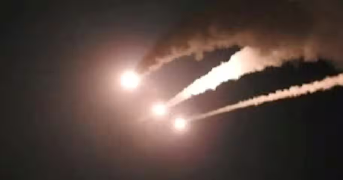

The renewed military escalation between the United States and Iran intensified on Friday, with US forces launching a new round of air and naval strikes against Iranian targets, the seventh consecutive night of military operations. At the same time, Iran sent a strong message to Washington, warning that the US naval forces in the region are being constantly watched, and a major military response could be on the horizon
The latest strikes were carried out around 3 p.m. Eastern time on Friday, the US Central Command (CENTCOM) said. The US military said the operation is part of its ongoing campaign to degrade Iran’s military capabilities and reduce its ability to threaten regional security and commercial shipping routes.
The consecutive strikes involved US fighter jets, drones, and warships targeting dozens of Iranian military sites, including coastal surveillance sites, air defence systems, military logistics centres and maritime assets.
CENTCOM said the operations are intended to degrade Iran’s military infrastructure, while holding Tehran responsible for recent attacks on commercial shipping in the region.
Meanwhile, Iranian state media reported that three explosions were heard in the city of Sirik in Hormozgan Province during the latest wave of US strikes. Iranian reports also claimed that several civilians were killed or injured after parts of the country’s civilian infrastructure were hit during the attacks, further adding to tensions between the two countries.
The United States has also maintained a strong military presence across the region during the ongoing conflict. CENTCOM said that more than 50,000 American service members remain deployed across the region and are prepared to respond to any further escalation.
IRGC’s ‘Zero Hour’ warning
As the US continued its military campaign, Iran responded with a series of warnings and military announcements. The Islamic Revolutionary Guard Corps (IRGC) Navy claimed that it is closely monitoring every movement of US naval forces operating in the region. In a statement, the IRGC warned that American forces are moving closer to what it called the “zero hour” of operations against CENTCOM’s naval units, signalling Tehran’s retaliation capabilities if tensions continue to rise.
Shortly after the warning, Iran’s Army announced another military operation in the northern Indian Ocean. According to the Army’s Public Relations, its Navy fired coast-to-sea cruise missiles at what it described as an “aggressor” US vessel during the thirteenth phase of its military campaign named “Operation Lightning.”
Iranian authorities claimed the missile strike forced the American vessel to withdraw from the area and created panic among US forces. The United States has not publicly confirmed the Iranian claim.
Iran continues to target US assets in the Gulf
Iran has also continued its wider retaliatory campaign against American military assets across the Gulf region. Iranian armed forces and the IRGC have announced separate operations targeting US naval and military facilities in Qatar, Kuwait, Jordan, Oman, and Syria, saying the attacks are in response to repeated US strikes inside Iran.
The recent escalations follow the collapse of a 14-point memorandum of understanding that had previously served as a framework for reducing tensions between Washington and Tehran. With both sides continuing military operations and issuing increasingly strong warnings, fears of further destabilising the Gulf region, disrupting maritime security and triggering a wider conflict in one of the world’s most strategically important areas persists.
(with ANI inputs)