
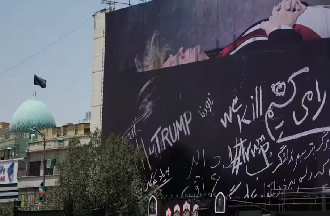

A towering billboard has gone up on Enghelab Square in the heart of Tehran, showing US President Donald Trump lying inside an open black coffin, as speculation swirls over an alleged Iranian plot against his life. The display sits close to a statue of the clenched fist of the late Supreme Leader Ayatollah Ali Khamenei, who was killed at the outset of the war between the US, Israel, and Iran. Together, the two structures form a defiant piece of political theatre for anyone passing through one of the capital’s busiest junctions.
Public squares have long served as Iran’s canvas for political messaging, and since fighting broke out in late February, that tradition has taken on new urgency. Revolutionary imagery, war memorials and pointed slogans have sprung up across some of Tehran’s most visible streets as part of the state’s wider communications push.
In the latest artwork, Trump’s body appears with tousled hair, eyes and mouth shut, and hands folded over a red tie resting on his stomach, his feet jutting upright at the coffin’s edge. Scrawled across the black casket, in both Persian and English, are the words “We Will Kill Trump”.
The white lettering echoes the memorial boards put up for mourners during Khamenei’s funeral rites, and includes tributes describing the former Supreme Leader as a martyr, alongside a line reading “In memory of Minab’s children”, a nod to the elementary school hit by a strike in the southern city of Minab on the war’s opening day, February 28th.
A Familiar Pattern Of Menace
This is far from the first time Tehran’s billboards have aimed at Washington. Back in May, a bilingual hoarding aimed squarely at American audiences showed Trump’s mouth stitched shut, layered over an image of the Strait of Hormuz beneath the words “The Breaking Point”. Another display cast Iran’s military strength through the image of a vast fishing net stretched across the Persian Gulf, snaring American aircraft, drones, and warships within it.
What sets the new coffin billboard apart is its bluntness. The messaging arrives against a backdrop of public fury among ordinary Iranians seeking retribution for Khamenei’s death, and a conservative Iranian newspaper has separately published a hit list naming thirteen foreign leaders as potential targets, including Trump, Israeli Prime Minister Benjamin Netanyahu and British Prime Minister Keir Starmer.
Warning From Israel, Response From Washington
Days before the billboard appeared, Israeli intelligence reportedly passed Washington a fresh warning about an alleged Iranian assassination plot targeting Trump. The Wall Street Journal reported that Israel’s dossier pointed to Tehran actively planning to kill the president, while CNN said American agencies had already been fielding a steady flow of threat intelligence in recent weeks, though officials described the Israeli tip-off as the first naming a specific plot.
Trump responded with characteristic bluntness, declaring that “1,000 missiles are locked and loaded and aimed at the Islamic Republic of Iran”, with thousands more standing by should Tehran act on threats against him. He added that orders were already in place for the military to strike back immediately in the event of an attempt on his life.
Strikes Continue As Ceasefire Talks Falter
The billboard’s appearance coincides with a fresh wave of American strikes on Iranian territory. On Wednesday, US forces hit military assets said to threaten commercial shipping through the Strait of Hormuz, with Trump warning that Washington could widen its campaign unless Tehran returned to the negotiating table. US Central Command said the strikes were intended to degrade Iran’s ability to menace vessels passing through the strategic waterway, and the military separately confirmed it had disabled an empty oil tanker accused of attempting to slip past the naval blockade of Iranian ports.
The renewed hostilities come barely a month after Washington and Tehran signed a memorandum of understanding aimed at ending the conflict. Despite the fresh violence, mediated talks between the two sides have not formally collapsed.