
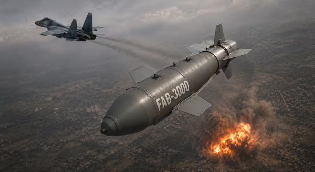

There has been a notable increase in the deployment of massive and destructive bombs by the Russian military along the Ukrainian frontline, including the FAB-3000 heavy explosive glide bomb. From the official statements from the Russian Ministry of Defence, the aerospace forces launched an attack against the towns of Orikhiv in the Zaporizhzhia district and Shchurove in the Donetsk district. The attack is reported to have wiped out the temporary deployment base of the Ukraine’s 63rd Mechanized Brigade.
Exploring Russia’s 3-ton aerial monster: FAB-3000
One of the heaviest bombs in the arsenal of Russia is the FAB-3000. Weighing 3,000 kilograms (about 3 tons), the Soviet-made bomb has about 1.4 tons of high explosives inside and is designed to flatten fortified buildings made of concrete, underground shelters, and defense centers for industries.
Significantly, Russia has updated these gigantic arms through equipping them with UMPK (Universal Modular Platform Kit) glide modules. In addition to the wings and satellite-guided tails, these modules make traditional ‘dumb’ free-falling bombs into long-distance precision weapons.
Pilot’s security: With the help of wings, Russian tactical jets such as the Su-34 fighter bomber can launch the munition at dozens of kilometers from the target being in the safety of a distance out of reach of the Ukrainian air defense system.
Explosion radius: According to the analysis provided by defense experts, one FAB-3000 explosion forms the area of absolute destruction at a distance of over 230 meters and retains lethal power within 1,200 meters due to shock waves and shrapnels moving at supersonic speeds.
Russia adopts ‘deep battle’ interdiction approach
FAB-3000 bombs used in Shchurove (Donetsk), Ustynivka, and Blahodativka (Kharkiv region) represent Moscow’s adoption of a “Deep Battle” concept. Instead of attacking the trenches directly, Russian troops use satellite-guided heavy ordinance to strike logistics nodes, ammunition storage facilities, and command centers located slightly deeper behind the frontline.
By destroying these staging areas, Moscow aims to sever Ukrainian supply lines, prevent reinforcements from reaching the front, and force defending units into a tactical retreat.
Air superiority exposes Ukraine’s air defence deficit
The surge in glide bomb deployments highlights a critical vulnerability for Kyiv. While Ukraine continues to receive Western anti-aircraft support, its current supply of sophisticated air defense systems remains severely limited.
Military analysis: Ukrainian forces do not possess enough long-range systems to intercept the high-altitude Su-34 jets before they release their payloads. As a result, Russia is exploiting this gap to establish localized air superiority, turning the battlefield increasingly lethal.
With Russia maintaining intense offensive pressure across Donetsk, Kharkiv, and Zaporizhzhia, Ukraine finds itself grappling with severe ammunition shortages and troop exhaustion. International observers warn that the widespread use of these multi-ton precision glide bombs will prolong the war, inflict heavier casualties, and exacerbate the humanitarian crisis across the region.