
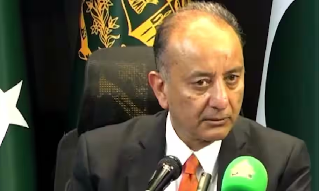

Pakistan has sharpened its rhetoric in the growing dispute with India over the Indus Waters Treaty (IWT), with Climate Change Minister Musadik Malik warning that Islamabad would “cut off those hands” that sought to claim Pakistan’s share of water under the agreement. The remarks come as tensions continue to rise after India placed the 1960 treaty in abeyance following the April 2025 Pahalgam terror attack.
Speaking at a joint press conference with Information Minister Attaullah Tarar, Malik accused India of trying to control Pakistan’s water supply. “There is a tap being controlled by the prime minister of a neighbouring country. He says he will not let even a drop of water flow into Pakistan,” Malik said, according to Dawn.
He then issued a stern warning and said, “We will cut off those hands that lay claim to our share of water.”
The comments were reported by Pakistani broadcaster 24NewsHD and several other media outlets. Video clips of the remarks also circulated online, although their authenticity could not be independently verified.
Malik reiterated that Pakistan would protect its rights under the Indus Waters Treaty and would not allow India to obstruct water allocated to the country.
Pakistan says the treaty remains legally binding
At the same press conference, Information Minister Attaullah Tarar maintained that the Indus Waters Treaty remained in force and could not be suspended, revoked or amended unilaterally.
“Indus Treaty is still in force as India’s stance has not been accepted at any platform,” Tarar said.
He added that Prime Minister Shehbaz Sharif and Pakistan Army chief Field Marshal Asim Munir had consistently maintained that “water is our lifeline, as well as our red line.”
According to Dawn, Tarar argued that Pakistan’s rights under the treaty were protected under international law.
“Our people have a right to water through a legally enforceable treaty that was accepted by both countries, that remains implemented today,” he said.
He also claimed that Pakistan’s position had gained international recognition and announced that Islamabad would host what it described as the first international seminar on the Indus Waters Treaty on Tuesday. The event, he said, would bring together legal experts, water specialists and foreign delegates to discuss the treaty’s legal and technical aspects.
Treaty under renewed strain
Brokered by the World Bank in 1960, the Indus Waters Treaty governs the sharing of the Indus river system between India and Pakistan. Under the agreement, India has rights over the eastern rivers, Ravi, Beas, and Sutlej, while Pakistan receives most of the waters of the western rivers, Indus, Jhelum, and Chenab.
The treaty remained intact through decades of conflict before relations deteriorated after the Pahalgam terror attack, in which 26 people were killed.
Following the attack, India blamed Pakistan-backed terrorists and announced that the treaty would remain in abeyance until Pakistan “credibly and irrevocably” ended support for cross-border terrorism. Islamabad has denied the allegations and repeatedly challenged India’s decision.
Earlier, Pakistan Defence Minister Khawaja Asif also warned that the country could resort to military action if its water security was threatened.
“The moment we feel that our national security, and water is part of our national security, is being threatened, we will go to war against India. Definitely,” Asif told ARY News.
India says treaty no longer reflects present-day realities
India has defended its decision, arguing that the treaty, signed more than six decades ago, no longer reflects current realities.
Addressing the 62nd session of the United Nations Human Rights Council, India’s First Secretary to the UN, Anupama Singh, questioned Pakistan’s demand for continued cooperation under the agreement.
“Our position on the Indus Water Treaty is well known. It defies logic that a state which exports terror as an instrument of policy continues to demand the privileges of cooperation predicated on goodwill and friendship,” she said.
Calling the agreement outdated, Singh added, “A treaty negotiated in 1960 cannot be treated as a perpetual entitlement which is insulated from accountability, detached from present-day realities and untouched by the profound changes of the past six decades.”
She also urged Pakistan to address its internal challenges instead of raising bilateral issues at international forums, while reiterating India’s position that Jammu and Kashmir “was, is and will always remain an integral and inalienable part of India”.