
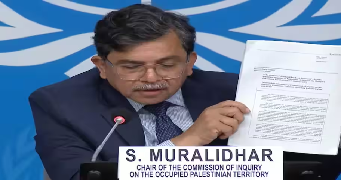

Former Orissa High Court Chief Justice and Senior Supreme Court Advocate S. Muralidhar appeared before the UN Human Rights Council in Geneva this week, where he presently chairs the UN Commission of Inquiry on the Occupied Palestinian Territory. He is the only Indian jurist leading one of the most high-profile international investigations in the world right now.
Videos from Justice Muralidhar’s briefing in Geneva have gone viral on social media. He presented the findings of the commission he heads and accused Israel of committing war crimes in Gaza. The moment also brought back stories of Indians who played a part in some of the world’s most important legal and human rights milestones.
From the years after World War II, Indian judges and diplomats have left their mark on international law in ways that many people still do not know about.
One of the earliest examples goes back to 1948, when the Universal Declaration of Human Rights was being drafted at the United Nations. The original wording of Article 1 read, “All men are born free and equal.”
India’s representative to the Human Rights Commission, Hansa Mehta, objected to the phrasing. She argued that the language excluded women in spirit, even if not in intent. Her push led to a revision. The sentence was changed to “all human beings are born free and equal”.
The edit was small on paper, but those words changed human rights documents for decades to come. It moved away from gendered language and set a standard that still appears in international legal texts today.
That same year, an Indian voice also played a role in one of the biggest legal debates of the time. The Tokyo War Crimes Tribunal was set up to try 25 senior Japanese leaders after the World War II. Eleven judges from 11 different countries were appointed to hear the cases. Most of the bench found the accused guilty of war crimes.
However, one judge, Justice Radha Binod Pal of the Calcutta High Court, wrote a 1235-page dissent. He questioned the structure of the tribunal and its selectivity in addressing wartime actions. He asked how the proceedings could deal only with the defeated side while leaving out the actions of the victorious powers, including the atomic bombings of Hiroshima and Nagasaki.
His view was rejected by the West, but in Japan, his dissent took on a different life. It is still studied in legal circles, and a monument in Tokyo stands in his memory.
These events happened many years apart, but they carry the same message. Indian judges and legal experts have often been part of important moments in international law. Sometimes they helped change the language of these ideas, and sometimes they questioned the way things were being done.
Justice Muralidhar’s role at the United Nations is another example of that history. It shows how Indian voices continue to be part of important legal and human rights efforts that have been going on for decades.