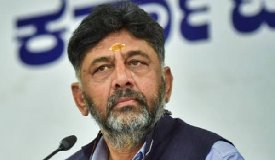

Karnataka Chief Minister DK Shivakumar has further strengthened his image as the “Chanakya of the Congress” after successfully leading the party to a major victory in the recent Legislative Council (MLC) elections.
Known for his political strategies and crisis management skills, Shivakumar managed to secure victory for all five Congress candidates who contested the elections. Interestingly, the party’s fifth candidate, Vinay Karthik, who was expected to win with only the required number of votes, secured the biggest victory margin among all five Congress nominees. The election was Shivakumar’s first major political challenge after becoming Chief Minister. The Congress won five of the seven Legislative Council seats that went to polls on Thursday.
Just two weeks after taking charge, Shivakumar also delivered a political setback to Union Minister HD Kumaraswamy, with allegations that his strategy helped the Congress gain support through cross-voting by 11 MLAs.
Congress Performs Better Than Expected With Cross-Voting
The Janata Dal (Secular) had fielded Govind Raju to protect its 18-member strength in the Karnataka Assembly. Based on the numbers, Congress was expected to get around 140 votes with support from three Independents and two expelled BJP MLAs, Shivaram Hebbar and ST Somashekar.
However, the five Congress candidates received a total of 151 votes, much higher than expected. The result indicates that some MLAs from the Bharatiya Janata Party and JD(S) may have voted in favour of Congress candidates.
The JD(S) candidate, Govind Raju received only 14 votes, despite the BJP deciding to transfer four votes to support him.
Congress had fielded Vinay Karthik as its fifth candidate to ensure that extra votes were not wasted. Party leaders said the move was part of a strategy to make maximum use of available votes. Without the fifth candidate, Congress was expected to comfortably win four seats.
BJP and JD(S) Face Questions Over Cross-Voting
BJP leaders admitted that cross-voting affected their performance in the election. Leader of Opposition R Ashoka said the party had planned a fixed vote allocation, but the final results suggested that some MLAs did not follow the party line. He said three MLAs may have cross-voted and promised action after identifying those responsible.
“We will find out who betrayed the party and take action,” Ashoka said. The JD(S) also faced concerns over internal unity as its candidate received fewer votes than expected.
Congress leaders credited Shivakumar’s political planning for the result and claimed that both BJP and JD(S) failed to keep their MLAs united.
Congress Calls Result a Message Ahead of 2028 Elections
Congress leaders said the MLC results showed growing support for the party’s government and its welfare schemes. Congress General Secretary Randeep Singh Surjewala said Congress had 135 votes but its candidates received 151 votes, showing support beyond its own numbers. He said the result reflected confidence in the government’s five guarantee schemes, under which around Rs 56,000 crore is transferred annually to beneficiaries.
claimed that BJP and JD(S) leaders opposed these schemes, but their own MLAs supported the Congress government through their votes.
Meanwhile, expelled BJP MLAs ST Somashekar, A Shivaram Hebbar, and Basanagouda Patil Yatnal, along with JD(S) leader GT Deve Gowda, said they voted according to their “conscience.”
BJP Faces Internal Review, JD(S) Worries About Unity
The BJP had to go into a second round to secure victory for its second candidate. One BJP candidate missed the required votes by one vote, while another vote was declared invalid. BJP leaders admitted that better coordination could have changed the result. Congress leaders described the outcome as a failure of BJP and JD(S) leadership to maintain unity among their MLAs. They said the results highlighted problems within the opposition parties and showed stronger coordination within Congress.
Following the defeat, the BJP started internal discussions to identify MLAs involved in cross-voting, while the JD(S) began facing questions over its internal discipline and future political strategy.