
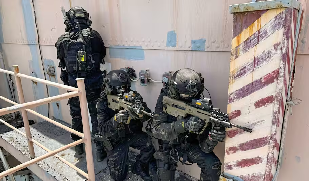

For the first time in the history of the Amarnath Yatra, the elite Special Frontier Force (SFF), also known as the Vikas Battalion, has been deployed for pilgrimage security. The force has been positioned on high-altitude ridges overlooking the Pahalgam route amid heightened security concerns following the recent terror attack and reports of terrorist presence in the region.
Elite force deployed on high-altitude ridges
The Vikas Battalion has been deployed on the high ridges overlooking the Pahalgam pilgrimage route.
The SFF is a secretive elite Indian force that operates in mountainous terrain above 17,000 feet, where even breathing is difficult. The unit specialises in high-altitude warfare and covert operations. It is one of India’s least-publicised but most capable military formations.
For the first time, these elite soldiers are monitoring the high ridges and strategic vantage points overlooking the route from Pahalgam to the holy cave shrine. They are providing an additional layer of security across the rugged mountain terrain.
Deployment follows security concerns
The deployment comes amid heightened security concerns after the terror attack in Pahalgam and continued reports about the presence of Pakistani terrorists in the region.
Officials aim to ensure strong security for the hundreds of thousands of pilgrims undertaking the journey to the 12,756-foot-high cave shrine, which houses the naturally formed ice Shivling.
Senior security officials said the SFF battalion has been tasked with monitoring mountain peaks and upper forest areas surrounding the pilgrimage route. The force will also conduct search and sanitisation operations to detect and neutralise potential threats.
The Vikas unit has been assigned responsibility for securing high-altitude ridges and key observation points. This marks the first time these mountain warfare specialists have been deployed to secure strategic positions along the pilgrimage route.
History and role of the Special Frontier Force
The Special Frontier Force was formed after the 1962 India-China war. The force has built a reputation for operating in some of the toughest environments.
Comprising Tibetan refugees, Khampa fighters, and Gorkha personnel from Nepal, the force functions under the supervision of India’s intelligence establishment. It is directly controlled by RAW, while the Ministry of Defence retains operational control.
Key operations involving the SFF
The force played a significant role in the liberation of Bangladesh by securing the Chittagong Hill Tracts and destroying Pakistani positions.
Operation Blue Star (1984)
The force was secretly deployed during the operation at the Golden Temple in Amritsar.
Operation Meghdoot (1984)
The SFF played a key role in helping India secure control of the Siachen Glacier.
Operation Vijay (1999)
The unit was secretly deployed to support Indian Army formations during the Kargil War.
Operation Snow Leopard (2020)
SFF personnel were commended for occupying and maintaining strategic heights against Chinese incursions along the Line of Actual Control in Ladakh.
Record security arrangements for Amarnath Yatra
Officials said the deployment reflects the government’s focus on using specialised resources for this year’s pilgrimage, which has recorded more than 3.5 lakh pre-registrations.
The deployment of the Special Frontier Force has been made to address security vulnerabilities in high-altitude mountain terrain. The force is trained to dominate elevated areas and secure critical observation points overlooking the pilgrimage route.
While the Jammu and Kashmir Police, Indian Army, and Central Armed Police Forces secure the main tracks and lower areas, the SFF will operate in higher regions to prevent infiltration, ambushes, and sabotage attempts from elevated positions.
Largest-ever security deployment approved
Security arrangements for the Amarnath Yatra are the strongest ever.
Along with the deployment of the elite Vikas Battalion, the Union Ministry of Home Affairs has approved the highest number of security personnel for the pilgrimage.
More than 100,000 security personnel from the CRPF, BSF, ITBP, SSB, and Jammu and Kashmir Police have been deployed. The ministry has also sanctioned more than 670 Central Armed Police Force companies to secure transit routes, highways, and camps.
Technology-driven surveillance system
To strengthen security in high-altitude areas, authorities have installed more than 400 CCTV and facial recognition cameras along the route.
A total of 28 elevated security watchtowers, double last year’s number, have also been established. Drones and a real-time facial recognition network will support surveillance operations.
Three command centres have been set up to monitor all security systems.
QR verification and RFID tracking
Security forces will use a QR-based Pehchan App to instantly verify registered local service providers.
The system will help prevent unregistered or suspicious individuals from accessing the pilgrimage route, even during internet outages.
Officials have also made Radio Frequency Identification (RFID) cards mandatory for pilgrims. The cards will help authorities track, manage, and ensure the safety of pilgrims travelling along the mountain route to the holy cave shrine.
Security along Jammu-Srinagar highway
Security personnel will also guard the Jammu-Srinagar National Highway, which connects the Bhagwati Nagar camp in Jammu with the Nunwan base camp in Pahalgam and the Baltal base camp.
Officials said the multi-layered security grid has been designed to ensure the safe and smooth conduct of the annual pilgrimage.