
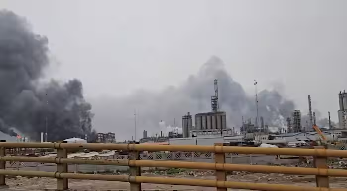

The Israeli military confirmed carrying out targeted airstrikes against a key industrial facility in southwestern Iran, signaling a significant escalation and aggressive expansion of its cross-border military operations.
In a short operational update on social media platform X, the military apparatus revealed that the Israeli Air Force had recently “attacked several targets at the petrochemical complex in Mahshahr”, situated in the strategic, energy-rich coastal belt of Iran.
The rapid use of air assets targeting Iran’s industrial infrastructure reflects a significant tactical escalation as tensions and direct confrontations between the two regional rivals continue to grow.
Military authorities did not immediately reveal the exact scale of the damage or specify which facilities and assets were affected during the low-altitude strike missions.
However, defence officials said additional information would be released once post-strike assessments are completed, stating that “more details will be shared soon.”
The strikes on Iran’s industrial facilities came amid a wider and increasingly volatile exchange of hostilities on Monday, when air raid sirens sounded across central and southern Israel following a fresh missile attack launched by Iran, according to Iranian news agency ISNA.
In a statement posted on social media platform X, the Israeli Air Force confirmed the ongoing cross-border developments and said its advanced air defence systems were actively intercepting and responding to the incoming missile threats.
“The IDF identified that a short while ago, missiles were launched from Iran toward the territory of the State of Israel. The defence systems are operating to intercept the threat,” the Israeli Air Force stated.
Taking to social media platform X from an emergency bunker, the United States Ambassador to Israel, Mike Huckabee, detailed the intense kinetic activity taking place in the skies overhead, writing, “In the shelter now. Hearing loud booms overhead. Hopefully it’s the interception.”
Highlighting the deep diplomatic and security frustrations surrounding the persistent multi-front hostilities, the US envoy added, “Another day we live under threat of crazed Iranian regime.”
Following that initial exchange, the Islamic Revolutionary Guard Corps issued an explicit warning designed to deter further countermeasures, threatening broader responses that “will encompass all American and Zionist targets throughout the region,” specifically pointing to prospective operations stretching across Lebanon, the Iranian coast, and maritime assets navigating the Strait of Hormuz.
The group published a short declaration on its official website, warning that “if America intervenes in the confrontation, we will target its bases and interests in Iraq and the region.”
“We’re very close. I would say an agreement would be signed on Monday, Tuesday or Wednesday of this coming week. And now this takes place,” Trump told Fox News, before directly addressing the leadership in Tehran: “You’ve shot your missiles, that’s enough. Get back to the table and make a deal.”
According to Axios, Trump held an immediate phone call with Netanyahu shortly after the initial Iranian salvo in a direct bid to prevent a broader multi-front war from collapsing the talks.
Trump publicly minimised the tactical impact of the initial barrage to reduce the political pressure on Israel to retaliate, telling Axios, “The Iranian strikes didn’t hurt anybody. Hopefully Israel is not going to retaliate.”
While talking to the Financial Times, Trump stressed that Netanyahu would lack the political leverage to block a wider bilateral agreement between Washington and Tehran, confidently asserting, “He won’t have any choice.”