
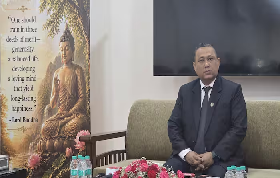

Days after Nepal Prime Minister Balendra Shah’s parliamentary address seeking the United Kingdom’s mediation to resolve the Lipulek-Limpiyadhura border issue with India, Nepal’s Foreign Minister Shishir Khanal overplayed the Prime Minister’s remarks in New Delhi, saying, “We were not asking for mediation from the UK, just access to the library.” On Sunday, during a press conference in New Delhi, Nepal’s Foreign Minister further stressed its claims on Lipulek, saying, “Nepal has sent a diplomatic note to India on (Lipulek-Limpiyadhura). Land belongs to us, it’s our historical claim.”
Earlier in late May, Nepali PM Balen Shah acknowledged mutual encroachments in some border areas and referenced Nepal’s conversations with China and the UK. He pointed to the colonial-era Sugauli Treaty of 1816 as a historical root, suggesting Britain’s perspective might help untangle complex legacy issues.
The remarks stirred ripples in both countries, prompting India to firmly reiterate that border matters must remain strictly bilateral.
Khanal, representing the Rastriya Swatantra Party-led government, presented a pragmatic and forward-looking tone. “We carry no old baggage,” he stated, signaling a clean slate focused on results rather than past frictions.
In meetings with External Affairs Minister S. Jaishankar, the Nepali minister described India as Nepal’s “most important partner” and highlighted a shared commitment to economic transformation, connectivity, energy cooperation, trade, and people-to-people ties.
Khanal’s approach underscores a “new chapter.” Discussions covered UPI-NPI linkage for easier remittances, handover of rebuilt health facilities and heritage sites, and language tools to bridge communities. These steps reflect everyday realities: traders crossing borders, families connected across the Terai, pilgrims journeying together, and young people dreaming of shared prosperity
India-Nepal ties built on strong foundation
Earlier, External Affairs Minister S Jaishankar on Saturday emphasized that, “India and Nepal share a very special relationship… one which is built on a strong foundation of vibrant people-to-people ties, cross-border connections, and shared cultural and religious traditions. It is anchored by shared trust, goodwill, and mutual benefit. Our bilateral ties have steadily developed in areas like trade, commerce, investment, energy, development cooperation, education, disaster response, and culture,” Jaishankar said.
“Today we have an opportunity to also take it forward in many other areas, in newer domains like startups, AI, information technology, renewable energy, and others. We collaborate closely to maintain security along our long and uniquely open border,” the EAM further added.
Khanal laid focus on a “genuinely transformative relationship.” In a region recently in headlines for border tension, this visit offers a quieter strengthening of ties between two sovereign neighbours, choosing partnership over pointed remarks, pragmatism over posturing, and friendship over friction. The visit also stressed sensitive boundary questions, but the tone from Kathmandu now leans clearly toward collaboration, taking a softer tone.
India-Nepal border dispute
The India-Nepal-China Lipulekh-Limpiyadhura-Kalapani area, spanning roughly 335 square kilometres, remains a persistent point of tension in India-Nepal relations.
Nepal bases its territorial claims on the 1815 Sugauli Treaty with British India, whereas India exercises effective administrative control over the region. The area is strategically significant, particularly the Lipulekh Pass, which serves as a key trade route and the main corridor for the annual Kailash Mansarovar Yatra.