
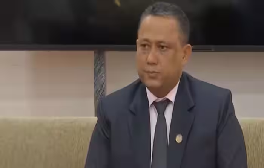

Nepal’s Foreign Minister Shisir Khanal on Sunday called for a development-focused partnership with India, stating that Kathmandu is keen to work closely with a “rising India” that has emerged as a major economic and technological power.
Speaking at a media briefing during his official visit to India, Khanal highlighted the strong civilizational and cultural bonds between the two countries, describing their relationship as one that goes well beyond mere geography.
“We’re not merely neighbours on the map; we’re children of the same rivers,” Khanal stated, while highlighting that the press plays a vital role in shaping public understanding of bilateral engagements.
“In vibrant, pluralistic democracies like ours, the media is the ultimate custodian of the narrative of our visits,” he said.
The minister stressed that Nepal’s current political leadership is determined to move past traditional geopolitical tensions and instead prioritise progressive development, stronger connectivity, and robust economic growth.
“When we look across the border, we see India as an economic powerhouse,” Khanal said. “We see a rising India that has redefined itself on the global stage as a dynamic, fast-growing technology and economic power. We want to engage with this India of aspiration, innovation, and execution.”
While outlining his high-level diplomatic engagements in the national capital, Khanal said he had extensive and detailed discussions with External Affairs Minister S Jaishankar on a broad range of issues vital to bilateral cooperation.
“Our discussions covered the full spectrum of the Nepal-India relationship, including trade, cross-border connectivity, energy partnership, water resources management, and people-to-people ties,” he affirmed.
The minister reiterated that Nepal aims to put economic transformation at the heart of its engagement with India, firmly moving away from viewing bilateral relations through the prism of outdated geopolitical rivalries.
Highlighting key recent achievements in bilateral cooperation, Khanal announced the operationalisation of cross-border digital payment transactions under an MoU between Nepal’s NCHL and India’s NPCI.
He explained that the initiative would connect the payment systems of both countries, enabling UPI-style cross-border transactions that would directly benefit entrepreneurs, tourists, and ordinary citizens on both sides of the border.
Further highlighting the strong developmental partnership, Khanal announced the formal handover of 72 health-sector projects and 12 cultural-sector reconstruction projects in Nepal, which were completed with Indian assistance following the 2015 earthquake.
The minister added that both countries are actively expanding cooperation in digital public infrastructure and emerging technologies. An MoU was signed between Kathmandu University’s Centre for Digital Public Infrastructure and Artificial Intelligence and India’s Digital India Mission to deepen collaboration in the field.
Responding to questions about a possible upcoming visit by Nepal’s Prime Minister Balen Shah, Khanal said that Nepal’s leadership is strongly committed to delivering visible results for the people and advancing practical cooperation that brings tangible benefits on the ground.