
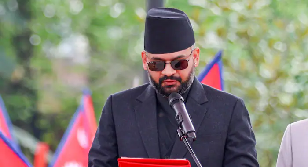

Nepal’s Foreign Ministry has issued a clarification on Prime Minister Balendra Shah’s recent parliamentary remarks regarding the India-Nepal border issue, stating that references to “cross-border occupation” pertain to no-man’s land areas rather than fresh territorial encroachment claims. In a detailed response to media queries, the ministry emphasized that Nepal’s position on the Lipulek-Limpiyadhura-Kalapani region remains unchanged.
The statement said that the Prime Minister wanted to use the term “cross-border holding”, and ended up using the term “cross-border occupation,” and the statement emphasized the territory overlapping in no man’s land, which is used by citizens of each other’s country.
The MoFA reiterated its long-standing claim based on the 1816 Sugauli Treaty and noted that diplomatic notes have already been exchanged with India on the Mansarovar pilgrimage route passing through the Lipulek area.
The statement explained, “The matter mentioned by the Honorable Prime Minister in Parliament primarily relates to the encroachment of the ‘Dashgaja’ area and ‘cross-border occupation’ that is, the exercise of ownership rights over land across the border.” It described situations where citizens of one country cultivate or reside on land technically belonging to the other due to the fixed boundary principle in riverine areas.
The ministry highlighted ongoing technical cooperation, including active work by a joint Technical Committee on mapping, border pillar construction, and data collection in disputed zones. It stressed both nations’ commitment to resolving issues through “diplomatic dialogue on the basis of historical treaties, agreements, and maps.”
The clarification follows PM Shah’s earlier remarks in parliament, on Sunday, where he suggested raising the Lipulek issue with the UK, citing its origins in British India, and proposed “table top” exercises with India to address the matter.
India’s stand on Lipulekh
The Nepalese Foreign Ministry further stated that the Technical Committee of Nepal and India is actively collecting data, repairing border pillars, and jointly studying these areas.
“The study of the Technical Committee has shown that in some places, the land currently under the use and enjoyment of Nepal may fall on the side of India and the land currently under the use and enjoyment of India may fall on the side of Nepal,” the ministry statement read.
The statement concluded that, in the spirit of the close bilateral relationship, Nepal remains committed to resolving border disputes through historical treaties, agreements, and joint maps.
“In line with the spirit and spirit of the close relations between Nepal and India, the Government of Nepal is always committed to resolving border-related issues through diplomatic negotiations based on historical treaties, agreements and maps,” the statement added.
Earlier this month, India rejected Nepal’s recent territorial claims over Lipulekh Pass, terming the unilateral artificial enlargement as “untenable” as Kathmandu objected to the Kailash Mansarovar route being undertaken through the region.
Ministry of External Affairs Spokesperson Randhir Jaiswal said in response to media queries regarding comments made by the Foreign Ministry of Nepal on the border issue in the context of the Kailash Mansarovar Yatra that India’s position in this regard had been consistent and clear.
“Lipulekh Pass has been a long-standing route for the Kailash Manasarovar Yatra since 1954, and the Yatra through this route has been going on for decades. This is not a new development”, he said.
Jaiswal further said that with regard to territorial claims, India has consistently maintained that such claims are neither justified nor based on historical facts and evidence.
“Such unilateral artificial enlargement of territorial claims is untenable,” he added.
Jasiwal stated that India remains open to constructive interaction with Nepal on all issues of the bilateral ties.
“India remains open to a constructive interaction with Nepal on all issues in the bilateral relationship, including on resolving agreed outstanding boundary issues through dialogue and diplomacy,” it added.