
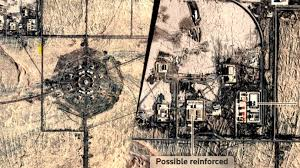

China is currently building a series of missile facilities, bunkers, and communication infrastructure throughout the remote deserts in its northwest regions in an effort believed by defense researchers to be unprecedented in terms of scale and strategy. Defense experts have characterised the construction program as an effort to ensure survivability and reliability of Beijing’s nuclear arsenal, described as “never before seen” and “extraordinary.”
The buildup appears to be centered primarily in key missile bases situated in Xinjiang and Gansu, which house some of the country’s longest-range intercontinental ballistic missiles (ICBMs), according to security experts. The construction effort seems to reflect a determined attempt by Beijing to build up defenses around the bases so as to guarantee successful retaliatory action in case of an initial attack on its nuclear capabilities.
“I have never seen anything quite like it. It’s an extraordinary effort,” Hans Kristensen, the director of the Federation of American Scientists’ Nuclear Information Project, commented on examining satellite images.
The expansion is taking place as tensions heighten amid growing nuclear competition and increasing geopolitical rifts between China and the United States, especially over the question of Taiwan.
Defense in the desert: The Hami expansion
Images obtained through satellite reveal the building of more than 80 concrete launch pads and three huge octagonal military structures constructed next to the Hami silo fields in Xinjiang.
Spanning across thousands of square kilometers of unforgiving desert landscapes, the expansive network reaches far beyond the existing silo areas. Experts who have analyzed the satellite images say that the facility is specifically built for facilitating different types of overlapping military operations, such as:
- Mobile missile launching
- Advanced air defense systems
- Electronic warfare units
- Satellite communication and command-control centers
Alexander Neill, an adjunct fellow at the Pacific Forum, said that the network represents a significant improvement in China’s strategic deterrence capabilities. By distributing multiple launch pads throughout the desert, the Chinese government increases the difficulty of targeting these facilities, thus increasing the chances of survival of China’s land-based nuclear forces during a war. Even though PLA has nuclear capabilities based on submarines and airplanes, this western network of silo fields constitutes China’s strategic deterrent.
China is building masses of launchpads near its nuclear missile silos
New satellite data shows a sprawling web of launchpads, bunkers and communications nodes next to silos that house missiles capable of reaching the U.S.
Creating the ‘second-strike’ capability
According to military analysts, this defense structure represents an immediate step towards creating China’s “second-strike” capability. It is an assured guarantee that the country will be able to deliver a catastrophic nuclear blow against an attacking enemy.
Chinese nuclear doctrine: Beijing has followed a strategy of “minimum deterrence” and a “no-first-use” doctrine until now.
Yet, the speedy modernization and opaque nature of the development caused alarm among Western diplomats and arms control experts. The situation has become more urgent amid the increased number of cross-strait incidents. As recently as last month, Chinese President Xi Jinping warned US President Donald Trump that any missteps in handling the issue of Taiwan may lead to putting bilateral ties in “a dangerous spot.”
Mysterious octagon military structures
Two giant octagon-shaped military facilities erected in eastern Xinjiang over the past six years form the heart of the complex network. While the first octagon is located about 140 kilometers southwest from the Hami silo fields, the second one is situated some 230 kilometers apart from there.
The following features of the high-security military installations were identified using satellite data:
- Heavily armored bunkers and secured storage zones
- Truck facilities for repairing military vehicles
- Specific airfields and railroads which connect missile fields with each other
New photos show active training exercises held in the area of the northern octagon with large tents, camouflage elements, and air-defense missile installations. Southern octagon serves as a logistics and transportation control center. It is connected via railways, pipelines, and underground structures to fuel facilities and other military complexes located all over Xinjiang Province.
Despite numerous findings, intelligence officials note that some information regarding the complex still needs further study. For example, the purpose of concrete pads is truck-based ballistic missiles or air defence systems. Also, the question of whether there are active warheads stored at the missile base hasn’t been answered yet.
Developing missile base
From the octagon’s perimeter run desert roads and tunnels through which fiber-optic communication lines may be passed. These cables are needed to provide the connection between distant missile launch pads and main command points. In addition, a recently discovered communications base in the vicinity of the northern octagon is provided with heavy-duty satellite dishes and tall transmitters.
Tong Zhao, a senior fellow from the Carnegie Endowment for International Peace, opines that the facility was most probably optimized for the sophisticated command, control, and communications systems in China’s nuclear arsenal at Hami.
Simultaneously, Beijing is spending large amounts of money to develop space-based early warning mechanisms for their country. Based on Pentagon reports, the Chinese Huoyan-1 satellite system has reached a stage wherein it can spot the arrival of an enemy ICBM within just 90 seconds of launch, relaying information to command facilities within minutes, thus allowing the Chinese to respond in time before any damage to their own silos takes place.
The presence of another octagonal base located near the Lop Nur nuclear testing area shows signs of its tactical importance only. Marked by the craters in the surrounding terrain and destroyed buildings alongside mock-ups of Western fighter jets, intelligence experts have concluded that this particular base is a target range for military use.
Global powers stunned by China’s strategic vision
According to Pentagon reports, by 2030, China will most probably continue to maintain a nuclear arsenal containing about 1,000 warheads along with about 100 ICBMs dispersed across three of its main silo complexes.