
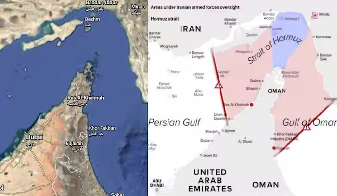

Amid the ongoing tensions with the United States and Israel in West Asia, which has highly impacted one of the most crucial maritime trade routes, the Strait of Hormuz, leading to blockades from both Tehran and Washington, Iranian authorities have established a new maritime body, the ‘Persian Gulf Strait Authority’ (PGSA), a formal governmental body to regulate maritime traffic through the Strait of Hormuz. Launched on May 5, 2026, the PGSA operates under the Iranian government in Tehran to authorize and oversee vessel transits in this critical waterway.
According to the framework, the Strait of Hormuz is described as a legal entity of Iran, requiring vessels to submit detailed information via email and obtain explicit approval before passage through the strait; transit without coordination will be deemed unauthorized.
The Hormuz Strait is a narrow sea passage that connects the Persian Gulf and the Gulf of Oman to the Arabian Sea.
At its narrowest, it spans between 33 and 50 kilometers. It carries about one-fifth of the world’s oil and significant liquefied natural gas volumes daily, making it vital for global energy security.
The PGSA, which has now claimed its presence on social media with an official website (pgsa.ir) and an active X account (@PGSA_Iran) for updates and coordination
Iranian authorities declared that “The Persian Gulf Strait Authority (PGSA) is the legal entity and representative authority of the Islamic Republic of Iran for managing the passage and transit through the Strait of Hormuz.”
Ebrahim Azizi, chairman of Iran’s parliamentary National Security and Foreign Policy Committee, supported the initiative in a televised interview, saying Iran had prepared “a mechanism to manage Hormuz traffic through a designated maritime route.”
Iran’s control over the defined maritime zone
The PGSA has outlined a controlled maritime zone extending from Kuh-e Mubarak in Iran to south of Fujairah in the UAE at the eastern entrance, and from the tip of Qeshm Island to Umm Al-Quwain in the UAE at the western entrance. All vessels in this zone for transit purposes must coordinate with and receive authorization from the Persian Gulf Strait Authority.
Reportedly, Iranian officials have emphasized the authority’s role in ensuring secure passage. The PGSA has indicated that fees for transit may apply, potentially payable in Bitcoin or Chinese yuan
How does PGSA raise concerns for the UAE
The United Arab Emirates (UAE), being one of the major users of the strait for its energy exports, has expressed concern over the PGSA’s defined zone, which reaches near its ports like Fujairah and Umm Al-Quwain. Fujairah serves as a key export terminal and bunkering hub.
Anwar Gargash, Emirati presidential adviser, responded firmly to the development, saying, “The regime is trying to establish a new reality born from a clear military defeat, but attempts to control the Strait of Hormuz or infringe on the UAE’s maritime sovereignty are nothing but pipe dreams.”
The UAE has also accelerated plans for alternative pipelines through Fujairah to reduce reliance on the strait. These developments add complexity to maritime operations for the UAE amid broader regional tensions.
The PGSA marks Iran’s effort to institutionalise its management of the Hormuz; meanwhile, Tehran is also holding discussions with Oman, with whom it shares the strategic waterway, to finalise cordination on transit mechanisms.