
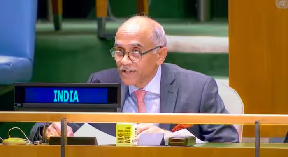

India’s Permanent Representative to the United Nations, Ambassador Harish Parvathaneni, highlighted Pakistan’s alleged role in civilian casualties in Afghanistan during the annual UN Security Council Open Debate on “Protection of Civilians in Armed Conflict.” Parvathaneni stated that the United Nations Assistance Mission in Afghanistan (UNAMA) documented 750 civilian deaths and injuries in the first three months of 2026 due to cross-border armed violence carried out by Pakistani military forces, primarily through airstrikes.
Highlighting Pakistan’s genocidal history, Parvathaneni said, “UNAMA attributed 94 out of 95 civilian casualty incidents to Pakistani security forces.”It is ironic that Pakistan, with its long-tainted record of genocidal acts, has chosen to refer to issues that are strictly internal to India.”
He specifically condemned a Pakistani airstrike on the Omid Addiction Treatment Hospital in Kabul, which UNAMA reported killed 269 civilians and injured 122 others. The strike occurred during the holy month of Ramadan, at the conclusion of tarawih evening prayers, when patients were leaving the mosque adjacent to the facility.
The Indian envoy further accused Pakistan of ignoring international calls to protect civilians and uphold humanitarian obligations.
“It is hypocritical to espouse high principles of international law while targeting innocent civilians in the dark. The air strikes by Pakistan occurred at the conclusion of tarawih evening prayers, when numerous patients were leaving the masjid, as per UNAMA,” he said.
“It bears emphasis that the UN Secretary General called on member states to uphold their international obligations in relation to the protection of civilians, including the principle of non-refoulement in the context of Afghanistan. Clearly, Pakistan has chosen to ignore this call completely,” he added.
India also raised the issue of cross-border terrorism and said states supporting terrorism must be held accountable.
“As per UNAMA, over 94,000 people were assessed as displaced due to cross-border armed violence perpetrated against Afghan civilians. But such heinous acts of aggression by Pakistan should not come as a surprise from a country that bombs its own people and conducts systematic genocide,” he said.
Parvathaneni also referred to Pakistan’s actions during the 1971 Bangladesh Liberation War.
“During Operation Searchlight in 1971, Pakistan sanctioned the systematic campaign of genocidal mass rape of 400,000 women citizens by its own army. Such inhuman conduct reflects Pakistan’s repeated attempts over decades to externalize internal failures through increasingly desperate acts of violence both within and beyond its borders. With no faith, no law, and no morality, the world can see through Pakistan’s propaganda,” he said.
India also voiced concern over attacks on civilians, hospitals, schools, and humanitarian workers in conflict zones across the world.
“In conclusion, India reiterates that the protection of civilians must remain at the center of the Security Council’s efforts to maintain international peace and security.
The international community must collectively work to restore and ensure respect for international humanitarian law, strengthen accountability, ensure humanitarian access, protect medical care, responsibly govern emerging technologies, and thereby alleviate the suffering of civilians affected by armed conflict,” he said.
The Indian envoy, during his concluding remarks, also added that the protection of civilians must remain central to the UNSC’s efforts to maintain international peace and security.