
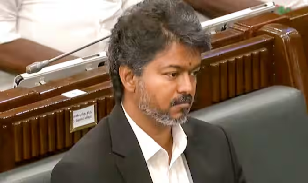

With elections concluded and the Vijay-led Tamil Nadu government weighing a three-language policy, with final decision pending on joining the Centre’s PM SHRI scheme, even as strong voices within the state continue to oppose any shift from the long-standing two-language formula of Tamil and English. School Education Minister A. Rajmohan has reiterated that the two-language policy remains a core principle of the ruling Tamilaga Vettri Kazhagam (TVK) and the new government under Chief Minister C. Joseph Vijay.
While the state is evaluating the benefits of the PM SHRI scheme for upgrading school infrastructure, there is no indication of compromising on the language policy.
As the government continues to ponder, MDMK General Secretary Vaiko issued a passionate appeal to Chief Minister Vijay, urging him ‘not to accept the PM SHRI scheme.’
Vaiko described it as an attempt to impose Hindi on Tamil Nadu through the back door.
Recalling the historic anti-Hindi agitations of 1938 and 1965, Vaiko highlighted the sacrifices of several Tamils who lost their lives in the struggle.
He quoted former Chief Minister C.N. Annadurai, who in 1968 declared, “Hindi shall never again have a place in Tamil Nadu. Only Tamil and English shall remain hereafter… this position can never be changed.”
Vaiko warned that accepting the three-language scheme would amount to a betrayal of those who fought for Tamil pride and self-respect. He said Tamil-conscious people would stand firmly behind the Vijay government if it firmly rejects the scheme.
Vijay’s stand against the Three-language policy
During the 2026 election campaign, Joseph Vijay and the TVK strongly criticised the three-language formula promoted under the National Education Policy (NEP) 2020.
Vijay had slammed the tussle between the Centre and the previous state government under DMK over the issue, calling it a “kindergarten fight” that ignored the real concerns of students.
Positioning TVK as a protector of Tamil identity and assuring voters that his party would never allow Hindi or any other language to be imposed in government schools. Vijay’s stance resonated deeply with voters who value linguistic pride, helping TVK secure a strong mandate.
BJP points Hypocrisy
With the Tamil Nadu government’s take on the three-language policy, the BJP has pointed out what it calls a clear contradiction.
BJP Tamil Nadu President K. Annamalai had earlier accused Vijay of double standards. He pointed out that ‘Vijay Vidhyashram’, a CBSE-affiliated private school in Padur, Chennai, which is closely linked to the current CM Vijay, who executed the land lease, follows the three-language curriculum, including Hindi as a third language alongside Tamil and English.
Annamalai questioned why Vijay’s own school and reportedly his children benefit from learning three languages, while his party opposes the same opportunity for children in government schools.
“Practice what you preach,” Annamalai had said, asking why three languages are acceptable for some but not for the masses.
BJP leaders argue that the three-language policy is flexible and not about compulsion but about giving students broader opportunities.
The Lotus party also accuses Vijay of following the traditional Dravidian playbook of opposing Hindi for political gains while privately opting for better language exposure.
The PM SHRI scheme, which offers significant central funding for model schools with modern facilities, but many in the southern state view its link to the three-language formula with suspicion rooted in decades of linguistic politics.
Earlier, the DMK government vocally opposed the scheme; with the new government in place, it faces the challenge of balancing strong Tamil sentiments, the need for quality education and funds, and sharp political scrutiny over consistency, with language, which remains an emotional and deeply personal issue in the state, intertwined with identity and history.