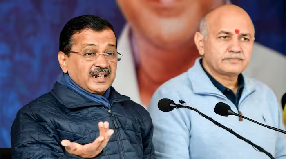

The Delhi High Court issued notices to Aam Aadmi Party (AAP) national convenor and former Delhi CM Arvind Kejriwal, ex-Deputy CM of Delhi Manish Sisodia and other party leaders in criminal contempt proceeding launched over alleged attempts to scandalise the judiciary in connection with the excise policy case.
In its order, a Division Bench comprising Justice Navin Chawla and Justice Ravinder Dudeja noted that the contempt proceedings had been initiated on the basis of an earlier order dated May 14, in which a single-judge Bench led by Justice Swarana Kanta Sharma had objected to material allegedly circulated in a “derogatory” manner against the judiciary.
“The proceedings have been initiated on the basis of the order dated May 14. The single judge has placed reliance on the material from social media posts and other electronic and publication records. The Registry is directed to preserve copies of the same and place them before this Court,” the Delhi High Court observed.
It also issued notice to the alleged contemnors, including AAP leaders Saurabh Bharadwaj, Vinay Mishra and Durgesh Pathak, giving them four weeks to file their replies.
The matter has been scheduled for further hearing on August 4. Although no counsel appeared on behalf of the alleged contemnors during the proceedings, the Bench headed by Justice Navin Chawla indicated that it may appoint an amicus curiae to assist the court in adjudicating the criminal contempt case.
The contempt of court case stemmed from an order passed previous week by a single-judge Bench of Justice Swarana Kanta Sharma, Who had noted that a “coordinated social media campaign” was conducted to scandalise the judiciary after her refusal to recuse from hearing pertains the excise policy case.
In a detailed order, Justice Sharma had held that the actions of the proposed contemnors were “calculated to scandalise the Court, lower the authority of the institution of justice, interfere with the administration of justice, and intimidate the independent exercise of judicial functions”.
The Delhi High Court had observed that while criticism of judicial orders is permissible, there exists “a very thin line” between fair criticism and attempts to portray a judge as biased through organised campaigns.
“The Court cannot permit erosion of the constitutional system and the justice delivery mechanism by tolerating such assaults in the name of public discourse,” the order had said.
Justice Sharma had also clarified that the initiation of contempt proceedings was not driven by personal grievance but was aimed at safeguarding the integrity of the judiciary. The judge subsequently recused from hearing the main excise policy case, observing that the matter could be heard by another Bench to avoid any perception of bias.
Following Justice Sharma’s recusal, a single-judge Bench of Justice Manoj Jain was constituted to hear the Central Bureau of Investigation (CBI)’s revision plea challenging the trial court order that had discharged Kejriwal, Sisodia and others in the alleged corruption case linked to the now-scrapped excise policy.
The trial court, in a judgment running into more than 1,100 paragraphs, had discharged all accused persons, holding that the now-scrapped excise policy was the outcome of a consultative and deliberative process and that the prosecution failed to establish an overarching conspiracy.
In its plea before the Delhi High Court, the CBI has alleged that the excise policy framed by the then AAP-led Delhi government was manipulated to favour select liquor traders in exchange for kickbacks.