
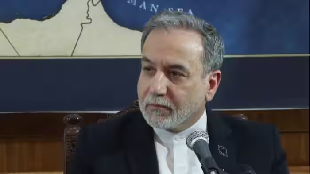

Iranian Foreign Minister Abbas Araghchi is currently in India for the 18th BRICS Foreign Ministers’ Meeting. Addressing a press conference on Friday, the Iranian leader highlighted several key points, including the tensions in the Strait of Hormuz amid ongoing friction between Washington and Tehran.
On Friday, he engaged in bilateral deliberations with External Affairs Minister S Jaishankar, focusing on regional security and cooperation.
Launching a scathing critique, Iranian Foreign Minister Araghchi asserted that the US remains the primary barrier to peace in West Asia.
“Now, after 40 days of war, when the US became hopeless of achieving any goal in their aggression against Iran, they offered negotiation… We have no trust in Americans… This is the main obstacle in the way of any diplomatic effort. We have every reason not to trust Americans, while they have no reason not to trust us,” the Iranian FM said.
“The current negotiation is suffering from a lack of trust. It is also suffering from the contradictory messages we receive from Americans. Every day is different from yesterday. A tweet today is different from yesterday’s… This is the problem, and it adds to the question of mistrust. We know that some spoilers try to derail diplomacy. The warmongers who want to drag the US again into another war. I hope that wisdom and diplomacy will finally prevail, and we go down the line of diplomacy to find a negotiated solution,” he also said.
Strait of Hormuz tensions
The Strait of Hormuz, a vital artery of global energy supply, has become the primary focus in the ongoing conflict between the US and Iran.
The results of a blockade of this shipping route have caused global concerns.
During the press conference, Araghchi clarified that the critical maritime route remains open to all vessels, with the exception of those belonging to nations in conflict with Iran.
“On the Strait of Hormuz, this is also our wish, that it will be fully reopened. As far as we are concerned, the Strait of Hormuz is open, and all vessels can pass except the vessels of those countries that are fighting with us… We have insecurity in the region because of the US aggression… The Strait is located in the territorial waters of Iran and Oman… Everything should be managed by Iran and Oman. This is what we are now consulting with each other to make sure that the arrangements, and that there will be a good administration in the Strait of Hormuz in the future, which guarantees the safe passage of all vessels,” he said.
Araghchi on Chabahar Port
Speaking about the Chabahar Port, Araghchi said, “Chabahar port is one of the symbols of cooperation between Iran and India. We are so glad that Indians played an important role in the development of that port. It is now somehow slowed down because of the US sanctions. But I am confident that this port would be like a golden gate for India to access Central Asia, the Caucasus and then Europe through this transit route and also for Europeans, Central Asians, and others to access the Indian Ocean.”
US-Iran tensions
This diplomatic friction comes as the broader landscape of West Asia remains locked in a stalemate. The beginning of hostilities on February 28 pitted the combined forces of the United States and Israel against Iran.
Though a fragile ceasefire is currently in place, the region is defined by a high-stakes maritime tug-of-war within the strategic Strait of Hormuz.
In a bid to cripple Tehran’s economic lifeline, the US has enforced a stringent naval blockade. In retaliation, Iran has imposed its own severe restrictions, partially shuttering the shipping lane to global traffic. This has left the global energy market in a state of volatile disruption.