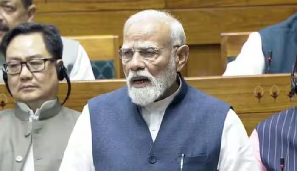

Prime Minister Narendra Modi addressed the Lok Sabha during the special three-day session on the women’s reservation bill and delimitation and delivered a sharp political message, warning that those who have opposed granting rights to women have historically faced electoral consequences.
Citing past trends, PM Modi asserted that women voters do not ‘forgive’ such opposition.
“Ever since the discussion on women’s reservation took place in our country, and every time elections have come around thereafter, whoever has opposed this right being granted to women, women have not forgiven them,” he stated.
In the 2024 elections, this did not happen, and it did not happen because everyone passed it unanimously then, so the issue itself did not remain,” the Prime Minister also said.
PM Modi also said that the women’s reservation bill will help change the “disha and dasha” (direction and condition) of the country’s politics by involving half of the population of the nation in decision-making.
Outlining the benefits of women’s reservation in achieving Viksit Bharat @2047, PM Modi said all those who have opposed this provision have been taught a lesson by women voters.
“We are privileged that we have an opportunity to give a new direction to the nation’s politics and strengthen democracy,” he said, urging parties not to see it through the prism of politics.Earlier, the introduction was approved in the Lok Sabha on Thursday, following a division of votes in the House. The development came after the Opposition pressed for a recorded vote, leading to a formal division process.
Union Law Minister Arjun Meghwal rose in the House to table the Bill, marking a key step in the legislative process.
The introduction follows an earlier round of voting in which Members of Parliament supported bringing the Bill forward for discussion. The Constitution (One Hundred and Thirty-First Amendment) Bill, 2026, and the Delimitation Bill 2026 and Union Territories Laws (Amendment) Bill, 2026, were introduced.
The Lok Sabha had voted in favour of introducing the Constitution (One Hundred and Thirty-First Amendment) Bill, 2026, after the Opposition demanded a division.
Following the use of vote slips, the distribution stood at 251 in support and 185 against, announced Speaker Om Birla, adding that it is subject to change.
The Lok Sabha typically relies on voice voting to pass motions; however, when the outcome is contested, a “division” is conducted. In such cases, the Automatic Vote Recorder system is used to register votes under “Ayes”, “Noes”, and “Abstain”.
Subsequently, as per IANS, vote slips were also utilised during the proceedings after the division, with a total of 333 members casting their votes and no abstentions recorded in that round.
“If any member wishes to change the vote, they may call for voting through slips,” the Lok Sabha Secretary General had earlier informed the House.
The Opposition had insisted on a division as the House took up voting on the introduction of the Women’s Reservation Bill. The motion required a simple majority to be carried, and the voting process was conducted accordingly amid heightened political engagement.