
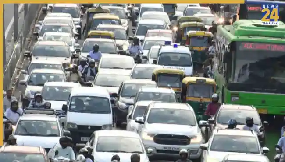

Chief Minister Rekha Gupta-led Delhi government on Saturday released the draft Electronic Vehicle (EV) Policy 2026-30, laying out a detailed roadmap to speed up the national capital’s shift to electric mobility. Among the key proposals in the draft, issued by the Transport Department’s EV Cell, are stricter fleet regulations, time-bound restrictions on petrol vehicles, incentives for EV adoption, and a massive expansion of charging infrastructure.
What is the draft EV policy?
The draft has been made available publicly for 30 days of stakeholder feedback before final approval. The draft EV policy aims to reduce vehicular emissions, which continue to be a key contributor to the capital’s air pollution crisis, especially during winter when smog envelopes the city.
Fixed phase-out timelines for autos, petrol two-wheelers
One of the key proposals in the draft includes clear electrification deadlines for major vehicle segments. From January 1, 2027, only electric three-wheelers will be allowed for registration in Delhi, followed by a complete shift to electric two-wheelers from April 1, 2028.
There are also restrictions for commercial fleets in the policy. New internal combustion engine vehicles will be restricted in aggregator-based operations, such as light goods vehicles up to 3.5 tonnes, from January 1, 2026. Furthermore, existing BS-VI two-wheelers will be allowed only until December 31, 2026.
Incentives, tax benefits and more
To drive early adoption, the draft EV policy introduces a time-specific incentive structure that gradually declines over 3 years. Electric two-wheelers worth Rs 2.25 lakh will get subsidies linked to battery capacity, with enhanced support during the 1st year and reduced benefits thereafter. Furthermore, electric cars will be eligible to receive incentives of up to Rs 1 lakh under certain conditions.
The draft also proposes a 100 percent waiver on road tax and registration fees for eligible EVs, while strong hybrid vehicles will be granted partial exemptions.
School buses, govt fleet set to be electrified
The draft EV policy draft electrification targets school buses, with 10 percent EV adoption in Year 2, 20 percent in Year 3, and 30 percent by 2030. This includes all hired and leased government vehicles.
Battery Recycling and Extended Producer Responsibility
The draft EV policy prioritizes sustainable battery management. The Delhi Pollution Control Committee has been designated to oversee the implementation of EPR rules, recycling, safe disposal mechanisms, etc.
Massive expansion of EV charging infrastructure rules
A key focus of the policy is the large-scale expansion of charging infrastructure across the national capital. Delhi Transco Limited has been appointed as the nodal agency tasked with planning, implementing, and integrating the battery-swapping network.
OEM rules, EV Fund and more
Original Equipment Manufacturers (OEMs) will need to ensure sufficient EV supply and set up charging infrastructure at dealerships. This system will be completely digital and paperless, covering approvals, applications, subsidy disbursal via DBT.