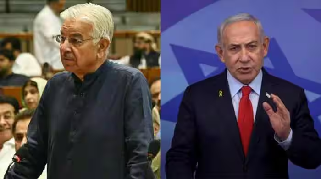

A diplomatic row has erupted between Israel and Pakistan just days before crucial United States-Iran talks scheduled in Islamabad, casting doubt over Pakistan’s role as a neutral mediator. The controversy was triggered by remarks from Pakistan’s Defence Minister Khawaja Muhammad Asif, who accused Israel of committing “genocide” in Lebanon and described the country as “evil and a curse for humanity” in a series of posts on X adding, “I hope and pray people who created this cancerous state on Palestinian land to get rid of European jews burn in hell.”
In a particularly contentious statement, he added, “Innocent citizens are being killed by Israel, first Gaza, then Iran and now Lebanon, bloodletting continues unabated”.
Israel responded sharply, with the Prime Minister’s Office condemning the remarks as “outrageous”.
“Pakistan Defence Minister’s call for Israel’s annihilation is outrageous. This is not a statement that can be tolerated from any government, especially not from one that claims to be a neutral arbiter for peace,” the statement said.
The Prime Minister’s Office:
Pakistan Defence Minister’s call for Israel’s annihilation is outrageous. This is not a statement that can be tolerated from any government, especially not from one that claims to be a neutral arbiter for peace. — Prime Minister of Israel (@IsraeliPM) April 9, 2026
Israel’s Foreign Minister Gideon Sa’ar also criticised the comments, calling them, “Blatant antisemitic blood libels from a government claiming to ‘mediate peace’… Calling the Jewish state ‘cancerous’ is effectively calling for its annihilation. Israel will defend itself against terrorists who vow its destruction.”
Israel views very gravely these blatant antisemitic blood libels from a government claiming to “mediate peace”.
Calling the Jewish state “cancerous” is effectively calling for its annihilation.
Israel will defend itself against terrorists who vow its destruction.The remarks have drawn criticism beyond Israel. US Congressman Josh Gottheimer described them as “vile rhetoric targeting Jews and Israel”, adding, “Hateful rhetoric like this is beyond unacceptable and unproductive at this fragile moment. This is not diplomacy and must be condemned.”
Commentators also questioned Pakistan’s neutrality. Analyst Emily Schrader labelled the remarks a “Jew-hating diatribe”, arguing that Pakistan “should not be permitted to mediate anything”.
Former US official Ellie Cohanim echoed these concerns, stating, “Many of us were concerned by the idea of the country which harboured and sheltered 9/11 mastermind Osama Bin Laden to serve as any kind of mediator… Pakistan has blown any notion of objectivity.”
The dispute comes at a critical moment, with Pakistan hosting high-stakes discussions between the United States and Iran aimed at easing escalating tensions in West Asia. Islamabad has been positioning itself as a diplomatic bridge and was recently credited with facilitating a temporary two-week ceasefire between Washington and Tehran.
An Iranian delegation is expected in Islamabad, while reports suggest Lebanon’s Prime Minister Nawaf Salam had also sought Pakistan’s support for securing an “immediate end” to Israeli strikes.
However, the latest controversy threatens to undermine these efforts. Observers note that the timing of Asif’s remarks, less than 50 hours before the talks, as delegations were arriving and security arrangements were being finalised, raises serious questions about Pakistan’s perceived neutrality.
The row follows earlier confusion over a ceasefire announcement attributed to Pakistan’s leadership, which suggested the truce applied “everywhere, including Lebanon”. Israel later clarified that Lebanon was not part of the agreement, maintaining that its military operations against Hezbollah remain separate.
Israeli forces have continued operations in Lebanon, including what has been described as a major bombardment on 8 April.
Despite the diplomatic fallout, preparations for the Islamabad talks are continuing under tight security, with international delegations already on the ground.
The negotiations are being viewed as one of the most significant US-Iran engagements in decades, with broader regional stability hanging in the balance. However, the current dispute has cast a shadow over Pakistan’s role, potentially complicating its efforts to act as a credible intermediary in an increasingly volatile region.