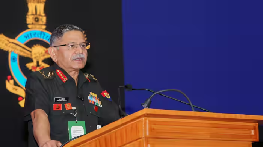

Chief of Army Staff General Upendra Dwivedi said that the Indian Armed Forces deliberately delayed planned strikes during last year’s Operation Sindoor in May 2025 to avoid disrespecting ‘Namaz’ at terrorist camps.
In what the Chief of Army Staff (COAS) called a conscious effort to balance military objectives with humanitarian considerations.
Speaking on the podcast “Before I Became Me” by IIMUN with host Rishabh Shah, the Army Chief said the operation involved flexible timing, but commanders chose restraint when they became aware of ongoing prayers at the target location.
“When we were to destroy these targets, the timing was two o’clock, four o’clock, anytime. But we made sure that when the people on the other side were going through their ‘namaz’ prayer in the terrorist camp, we said this time will not touch, because sabka malik ek hai. And that’s why we chose a time when we knew that it was not,” said COAS General Dwivedi.
His comments provide a rare window into the decision-making behind Operation Sindoor, revealing how planning went beyond tactical accuracy to incorporate respect for religious practices amid conflict.
They also highlight a leadership style that blends ethical considerations with military objectives.
According to the Army Chief, such decisions are not incidental but are part of a broader value system that guides the force in complex environments.
General Dwivedi also spoke about the personal influences that have shaped his leadership style, particularly the role of his daughters in shaping his views on hierarchy and gender within the Army.
On the induction of women into the Army, General Dwivedi said that his daughters always guide him in matters, including working norms.
“Now we are moving towards the induction of women in the Army. Questions of social change and workplace norms are important, and they give their input. I take their views seriously and implement them wherever needed,” the Army Chief said.
He said his daughters guide him on how best to approach these changes and help shape the way forward.
“They have taught me that you have to come down to interact with a particular person. You cannot be six feet tall always,” he said, adding that their perspectives have informed his approach to making the Army’s working norms more gender-neutral.
General Dwivedi stressed the value of adaptability and inner drive over mere academic scores in a frank reflection on his early years and military path.
The Army Chief shared how his time at Sainik School, Rewa, and the National Defence Academy (NDA) molded his leadership style and commitment to national service.
“Attitude and adaptability precede ability; marks are only a burning indicator of academic qualities, not your character,” General Dwivedi said.
He noted that while he was not always at the top of his class, his focus remained on understanding subjects and preparing for life beyond the classroom.
On the role of spirituality in maintaining composure during high-stakes operations. He revealed that he often refers to the Bhagavad Gita and other religious scriptures to navigate ethical dilemmas inherent in counter-terrorism efforts.