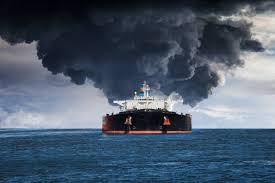

The Turkish merchant ship was hit by a drone off the coast of Istanbul in the Black Sea. The tanker, carrying 140,000 tons of oil, was struck by a drone 26 km from the Bosphorus. All 27 crew members were unaffected by the attack.
In a statement, Turkey’s Transport Minister Abdulkadir Uraloglu said that a foreign-flagged ship operated by a Turkish company, which had loaded crude oil from Russia, reported an explosion in its engine room after midnight.
“I can say that a foreign-flagged ship operated by a Turkish company, which had loaded crude oil from Russia, reported an explosion in its engine room after midnight to our emergency call centre,” the minister said, as quoted by NDTV.
No group or country has officially claimed responsibility for the attack on the Turkish-operated oil tanker.
This development is significant because there are seven major maritime chokepoints worldwide that are critical for global oil and energy shipments. These narrow passages handle more than 90% of the world’s seaborne oil trade, including the Malacca Strait, the Strait of Hormuz, the Danish Straits, the Bab al-Mandab Strait, the Turkish Straits (Bosphorus Strait), the Panama Canal, and the Suez Canal. An attack on any of these chokepoints increases strain on global energy supplies.
The global oil supply is already suffering due to the closure of the Strait of Hormuz and attacks by Iran on vessels. Iran is currently only allowing passage to ships from friendly nations, including China, Russia, India, Iraq, and Pakistan.
Meanwhile, Japan has started releasing oil from its strategic reserves to mitigate the economic impact of the ongoing conflict in West Asia. The government announced it will tap into 30 days’ worth of state-held oil reserves. This follows an earlier decision last Monday to begin drawing down 15 days’ worth of oil from private-sector stockpiles.
According to Japanese media reports, authorities plan to release approximately 8.5 million kilolitres of crude oil from 11 storage facilities nationwide.
Japan is particularly vulnerable to the current crisis because more than 90% of its crude oil imports come from West Asia. The effective closure of the Strait of Hormuz following the escalation of the US-Israel-Iran conflict in late February has caused sharp increases in global crude oil prices and domestic gasoline costs.
Middle East War and Tension in the Strait of Hormuz
Since the start of the war in the Middle East, after the US and Israel launched an attack on Iran on February 28, in which Supreme Leader Ayatollah Ali Khamenei and several other top officials were killed.
Operation Urja Suraksha
The Indian Navy has launched Operation Urja Suraksha to safeguard the nation’s energy interests amid escalating tensions in West Asia. As part of the operation, India has deployed more than five frontline warships around the critical maritime chokepoint of the Strait of Hormuz.
The primary goal is to protect India’s energy security. Currently, 22 vessels bound for India have been identified for safe escort, including 20 priority ships carrying essential cargo such as LNG, LPG, and crude oil.