

ong before “Hindenburg” became linked to financial headlines, it symbolised one of aviation’s darkest moments. In 1937, the German airship burst into flames mid-air. Today, airships are returning, with a very different mission.
India is developing an unmanned, high-altitude airship designed purely for surveillance, marking a shift toward smarter, cost-effective aerial monitoring.
DRDO’s High-Altitude Plan
The Defence Research and Development Organisation (DRDO) is building a High Altitude Pseudo Satellite (HAPS), designed to operate between 45,000 and 60,000 feet (14–18 km). At these heights, it remains largely beyond the reach of short-range and some medium-range air defence systems.
This vantage point allows it to observe deep inside enemy territory—up to around 20 km—making it a valuable asset for tactical planning and precision operations.
Satellites offer high-resolution imagery but come at a steep cost and operate over 100 miles above Earth, where they can be targeted by anti-satellite weapons.
HAPS, by contrast, offers persistent surveillance at lower cost. Its position in the stratosphere enables more focused and flexible monitoring without the same vulnerabilities.
Designed for Stealth
The airship will be built mostly from fabric with minimal metal, giving it a low Radar Cross Section (RCS) and making it harder to detect. Camera placement is also being optimized to reduce exposure.
While advanced systems like the S-400 could reach such altitudes, using them against a relatively low-cost airship may not be practical.
The platform is expected to use hydrogen, treated for fire resistance. Helium is safer but harder to source in large quantities. Early-stage work on the project is already underway.
Project Kusha Advances
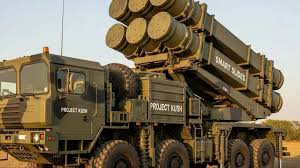
In parallel, DRDO and Bharat Electronics have completed initial trials of Project Kusha, an indigenous long-range air defence system. It is expected to have a range of 100–150 km, with future upgrades potentially extending beyond 350 km.
Changing the Surveillance Game
By combining altitude, endurance, and stealth, India’s HAPS could redefine aerial surveillance. As airships return in a new role, they may quietly reshape how modern conflicts are monitored and managed.