
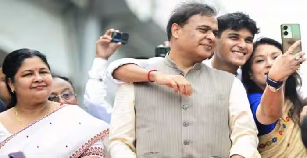

As Assam heads towards elections next month, the political contest has largely narrowed to a direct fight between the Bharatiya Janata Party (BJP) and the Congress, the principal forces leading their respective alliances in the state.
At the centre of the BJP’s campaign is Chief Minister Himanta Biswa Sarma, who has steadily grown into one of the party’s most influential leaders in the Northeast. As convenor of the North-East Democratic Alliance, Sarma’s rise since his departure from the Congress has been striking, cementing his position as a dominant political figure in the region.
A strong political position despite anti-incumbency
Facing his third consecutive bid for power, Sarma has managed to counter anti-incumbency concerns with a mix of political strategy and strong public outreach. Over the years, he has built a reputation as a shrewd operator and an effective campaigner.
Earlier this month, his Aashirvad Yatra drew large crowds across the state, signalling continued grassroots support. The BJP has also leaned on the government’s record in infrastructure development and welfare delivery, which has strengthened Sarma’s appeal among voters.
Key campaign issues and electoral advantage
A central plank of Sarma’s campaign has been his strong stance on land encroachment, particularly by alleged illegal immigrants from Bangladesh, an issue that carries deep emotional weight in Assam. This messaging has resonated with sections of the electorate.
The BJP also appears to have gained an edge from the 2023 delimitation exercise. The number of Muslim-majority constituencies has reduced from 35 to 24, a shift that could weaken the Congress and the All India United Democratic Front led by Badruddin Ajmal in their traditional strongholds.
At the same time, an increase in seats reserved for Scheduled Castes and Scheduled Tribes is expected to aid the BJP’s outreach among these communities.
The Opposition, led by the Congress, is grappling with organisational and leadership challenges despite forming a six-party alliance. Internal divisions and high-profile exits have further weakened its position.
Among those who have distanced themselves are Bhupen Bora and Pradyut Bordoloi, while Bordoloi’s son Prateek withdrew his candidature. The BJP has sought to capitalise on these developments by portraying the Congress as fragmented and lacking direction.
On the ground, the BJP continues to hold a strong position in Upper Assam. In Dibrugarh, the party has retained the parliamentary seat since 2014 and dominated most Assembly segments in 2021, barring one won by the Asom Gana Parishad.
However, Jorhat presents a more competitive picture. Congress leader Gaurav Gogoi won the parliamentary seat in 2024 by a margin of nearly 1.4 lakh votes. The BJP is now making a concerted push to regain lost ground in the region.
In Tinsukia, the BJP-led alliance has maintained a strong foothold, benefiting from support in tea garden belts and Assamese-dominated areas, winning consistently in the past two Assembly elections.
The NDA also retains influence in hill districts, where tribal voters have largely backed Sarma in autonomous council regions.
Central Assam and the Barak Valley are expected to witness close contests, given the mixed electoral trends in recent years. However, a possible split in minority votes between the Congress and AIUDF, once allies, could further complicate the Opposition’s prospects.
With Sarma’s growing stature, organisational strength, and favourable electoral shifts, the BJP enters the contest from a position of advantage. Yet, as voting approaches, regional dynamics and Opposition strategy will ultimately determine whether the Chief Minister secures a third term in office.