
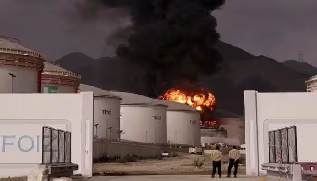

Since the beginning of US-Israeli attacks on Iran, Tehran has launched a series of strikes targeting American assets in Gulf nations. Airports, maritime lanes and oil infrastructure have all been targeted in the area. However, it is not simply the attacks that are noteworthy, but also the silence that ensues.
Despite possessing some of the most sophisticated Western military equipment, wealthy Gulf monarchies have refrained from launching direct counterattacks..
Wealthy Gulf monarchies, which are armed with some of the most advanced Western military systems, have not responded with direct counter strikes. The absence of retaliation has triggered a question: why are these heavily armed states holding back?
The fear that numbers explain
Security analysts point to a concept that is influencing decisions in Gulf capitals, an imbalance where a few key systems are highly vulnerable. They explained, “The issue is not about military strength on paper. It is about what happens when critical infrastructure is hit. The consequences are immediate and severe.”
Thanks to modern infrastructure and foreign investment, cities like Dubai, Abu Dhabi and Riyadh have developed into international economic centres. Systems, including electricity grids, logistics corridors and desalination plants, are crucial to these cities. Any disruption to these facilities can lead to a crisis.
Energy analyst Ellen Wald said in a recent briefing, “Much of the Gulf’s infrastructure is highly centralised, which makes it efficient but also creates points of risk.”
This concentration means that even low-cost drone attacks can create outsised damage.
Cheap drones, costly consequences
Military experts say the changing nature of warfare has added to these concerns. The development of drone technology has increased the impact of strikes while decreasing their cost. When a single site is targeted by a swarm of reasonably priced drones, the interruption can take days or weeks to fix.
The stakes are higher for nations whose drinking water is desalinated. A disruption in water supply can affect millions of residents. Investors, who are always sensitive to risks, tend to react immediately in such scenarios, pulling back capital at the first sign of instability.
The American security umbrella
The story does not end with infrastructure. The Gulf’s defence systems are tied to partnerships with United States. American technology, intelligence and logistical support have been the cornerstones of the military capabilities of nations like Saudi Arabia and the United Arab Emirates for decades.
Although it has led to dependence, this relationship has given security guarantees. Many advanced systems require continuous coordination with US platforms, including surveillance and satellite networks.
Speaking to Reuters, a former Pentagon official said, “These systems are integrated into a broader network. Sustained operations are difficult without American logistical backing.”
This dependence affects how far these countries can act on their own during a crisis.
A calculated pause, not hesitation
Behind closed doors, meticulous consideration often results in what appears to be restraint in public. Leaders in the Gulf are conscious that any escalation might lead to reprisals against the very mechanisms that support their economies.
However, the situation is also influenced by Washington’s geopolitical interests. Authorities in the United States are concerned about the stability of international energy markets. Increased hostilities in the Gulf might disrupt oil supplies and drive up prices, which would have a knock-on effect on the world economy.
A region defined by fragile balance
The present situation highlights a reality of modern geopolitics. Power is no longer measured only by military hardware. It is also characterised by infrastructure, durability and shock-absorbing capacity.
The difficulty for the Gulf states is to maintain economic prosperity in the face of an unstable security environment. And therefore, the silence after the strikes is not empty. It shows a complex calculation, where every move is measured against the risk of triggering a chain reaction.
Why they are not answering is no longer the question. How long this delicate balance can last in an area where the consequences of a single strike can reverberate well beyond the battlefield is the true question.