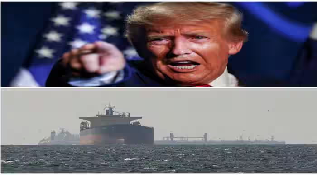

The strategic Strait of Hormuz has become a flashpoint for President Donald Trump as US-Israel war with Iran keeps on intensifying. Despite his repeated calls for warships to secure the vital waterway, European countries and other NATO allies have shown little interest in joining the effort.
On March 15, during an interview with the Financial Times, the US president issued warned European nations that failing to help reopen the Hormuz Strait could have “very bad” consequences for NATO’s future. He reiterated the same while talking to reporters aboard Air Force One on his return from Florida.
He said he hopes China will help before his planned meeting with President Xi Jinping in Beijing later this month, pointing out that Beijing gets “90 percent of its oil through this strait”. He added that while the meeting is scheduled for late March, he would like to see action taken beforehand. Trump also hinted that the trip could be delayed but offered no further details.
The comments followed a recent appeal in which he urged China, Australia, France, Japan, South Korea and the United Kingdom to participate in a “joint effort” to reopen the strait.
Oil prices surge as Strait is blocked
Iran has effectively restricted access to the narrow Hormuz Strait, the passage for roughly 20 percent of international oil trade. As a result, oil prices hovered around $100 per barrel on March 15.
Analysts warn that if the standoff continues, prices could jump further. Rising oil costs are creating domestic pressure on Trump, prompting the United States last week to permit India and several other nations to purchase Russian oil stranded at sea due to sanctions.
Trump’s position on Europe
Trump highlighted Europe and China’s heavy reliance on oil flowing through the Gulf. He cautioned allied nations that inaction could be “very bad for NATO’s future”, while emphasising he would be watching to see which countries step up to assist.
He refrained from naming specific nations in his latest statement but referenced NATO members whose own security he believes is at stake.
Two days earlier, Trump had posted on Truth Social that he expects China, France, Japan, South Korea, the UK and other nations to send ships to ensure the strait is protected from “completely exhausted threats”. He added that the United States has been lenient with European allies and that a lack of support could have long-term consequences for the alliance.
Trump also said that helping Ukraine, thousands of miles away, was a choice, but he emphasised that Washington expects reciprocity. He criticised allies for hesitating, citing Britain’s prime minister as initially reluctant to deploy two aircraft carriers to the strait.
Trump said, “Now that we have largely neutralised the threat, they said, ‘We want to send our carriers’. I told them, ‘I didn’t need you after winning the battle’.”
Responses to Trump’s warship appeal
Britain: A Ministry of Defence spokesperson said they are exploring multiple options with partners to ensure shipping security in the region. Earlier, Prime Minister Keir Starmer had initially refused US requests to use British bases for operations against Iranian missile sites but later approved “defensive” action.
China: The Chinese embassy in Washington told CNN that Beijing calls for an immediate end to hostilities but did not confirm whether it would respond to Trump’s request. The statement emphasised the responsibility of all parties to maintain stable and uninterrupted energy supplies.
Japan: Ahead of Prime Minister Fumio Suga’s US visit, Japan said that it had not received any formal request to assist in the strait, though officials said they are considering how to respond within existing legal constraints.
France: The French foreign ministry denied reports that it would deploy warships. President Emmanuel Macron said in a post that he urged Iran to cease attacks and affirmed France’s defensive position, emphasising freedom of navigation in the strait.
Germany: Foreign Minister Annalena Baerbock expressed doubts about expanding the EU’s existing naval Espides mission, citing limited effectiveness in securing the strait.
South Korea: Seoul said it is closely monitoring the war and evaluating measures to protect its citizens and secure energy supply routes.
Australia: Canberra stated it would not send warships, adding that it had not received requests and would not contribute militarily.
European Union: EU foreign ministers are discussing strengthening their naval mission in the Red Sea but are unlikely to expand operations to the blocked Hormuz Strait.
Spain: Spanish Prime Minister Pedro Sánchez voiced opposition to US-Israel actions against Iran, emphasising adherence to international law and peaceful resolution. Following these statements, Trump reportedly threatened to sever trade ties with Spain.
Iran shows willingness to talk
Trump claimed that Iran is eager to negotiate but is using artificial intelligence to spread misinformation. Speaking to reporters on Air Force One, he said, “Iran is desperate to reach an agreement. We are talking to them, but I don’t think they are ready, though they are very close.”
When asked if he was ready to declare victory over Iran, the president replied, “There is no reason to do that.”
He asserted that US strikes have caused enough damage that it could take Iran a decade to recover. He also alleged that images of large gatherings in support of Iran’s new Supreme Leader Mojtaba Khamenei, reports of “kamikaze boats” and attacks on USS Abraham Lincoln were AI-generated, though he provided no evidence.
Iran’s position
Foreign Minister Abbas Araghchi rejected claims that Tehran sought a ceasefire or negotiations. Speaking to CBS News, he said, “We have never asked for a ceasefire or talks. We see no reason to negotiate with Americans who decided to attack us while we were in discussions.”
He added that Iran is ready to hold talks with countries seeking safe passage through the Hormuz Strait. He said that India recently sent two ships safely through the strait. He credited the move to diplomatic efforts.
He also confirmed that Iran’s nuclear facilities are presently dismantled with no plans to rebuild, while Israeli and US military centres are now facing heavy missile attacks.
The Islamic Revolutionary Guard Corps, according to reports, stated that the Khorramshahr missiles were deployed for the first time in this operation, along with four strategic missiles and solid-fuel Sejil missiles.