

Written By : Gazi Abbas Shahid
With the United States embroiled in a rapidly-escalating military conflict with Iran, which is threatening to transform into a large scale regional war, China may find this an opportune moment to capture Taiwan.
What is China’s three-front strategy against India?
However, China faces one major opponent before its makes any move on Taiwan; India, which is why experts believe Beijing is working on a devious plan to engage India on multiple front, from the Himalayas to the sea.
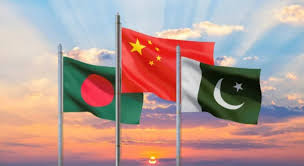
While China and its “iron brother” plan to engage India on land in the Himalayas, Beijing’s plot to open another front against New Delhi in the sea involves building strategic military partnerships with countries like Bangladesh and the Maldives.
The plan, experts believe, is designed to challenge India’s naval supremacy in the Indian Ocean as well as the Bay of Bengal.
Why a weakened Quad spells trouble for India?
With the Quad alliance of US, Australia, Japan, and India, which was designed to contain China’s influence in the region, significantly weakened during US President Donald Trump’s second term, China is presented with an opportunity to strengthen its position in the Bay of Bengal with the help of Bangladesh.
According to Wolfgang Petermann, a US Army foreign area officer currently assigned to the Defense Intelligence Agency, India could find itself embroiled on multiple front; China to the north, Pakistan to the west, and Bangladesh, which is connected to China and Pakistan, to the east, if the Quad remains in its current weakened state.
How China’s plan would affect its Taiwan plan?
In an article on ‘War on the Rocks’ website Petermann writes that China’s strategy is designed to prevent possible threat from India if Beijing launches a campaign to annex Taiwan in the near future.
According to Petermann, a three-front strategy will ensure China faces significantly less pressure from the Indian front, reducing the need to deploy a major portion of its military assets to the Indian Ocean or the Bay of Bengal as Pakistan and Bangladesh will engage India on two fronts.
This would allow China to counter US by deploying its most powerful military assets in the Western Pacific region, from the South China Sea to around the Senkaku/Diaoyu Islands or to the Korean Peninsula, Petermann writes.
What is China’s plan in Bay of Bengal?
Since the ouster of Sheikh Hasina in August 2024, China has developed close defense ties with Bangladesh, emerging as the largest largest source of funding for the modernization of the Bangladesh Navy, including the delivery of Type 035G diesel-electric attack submarines.
China is also funding, as well as providing technical assistance for the construction of a submarine base near Cox’s Bazar, while the inclusion of the Chittagong and Mongla Ports– Bangladesh’s two main ports– in China’s ambitious ‘Belt and Road Initiative’, has significantly increase the Chinese Navy’s operational range.
According to experts, by increasing investment and naval presence in Bangladesh, China aims to give a final shape to its “String of Pearls” strategy against India, and the gradual integration of the Bangladesh into its naval ecosystem would allow Beijing to deploy its ships and logistics whenever required.
Why China is arming Bangladesh’s air force?
As per a report by defense website War on the Rocks, China plans to arm Bangladesh with advanced air combat platforms and has already approved the sale of 20 J-10CE fighter jets to the Bangladesh Air Force for $2.2 billion.
Petermann believes that a combination of Chinese weapons, Pakistan’s military, and Bangladesh creates a lethal cocktail that could pose a significant security challenge for India, from the Bay of Bengal to the Indian Ocean.
This would force Indian to focus on two fronts simultaneously, rather than treating the Western theater as the primary axis, and being very careful in the distribution of its military assets, he observes.
Pakistan was the largest buyer of Chinese weapons between 2020-2024, and now Bangladesh has emerged as the second-largest importer of armaments from Beijing, highlighting a worrying pattern which India needs to be wary of.