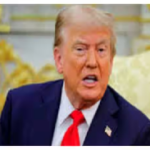
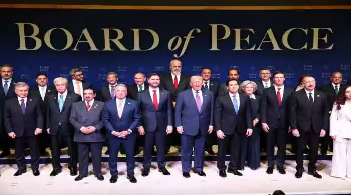

US President Donald Trump held the inaugural meeting of his ‘Board of Peace’ at the US Institute of Peace, bringing together representatives from select nations to propose reconstruction strategies and funding for Gaza. Though the gathering was aimed at showing global support for Gaza, it was marred by controversy.
Trump described the board as having “unlimited potential”, claiming it could become the most consequential international body in history. He will continue to be its chairman forever, even after leaving office. Critics, however, warn that the board’s growing mandate risks overshadowing established international institutions, including the United Nations.
Of the 50 countries invited to join the board, 26 confirmed their participation. Several major European powers have declined to join it, citing concerns over the board’s expanding charter and Trump’s decision to include leaders such as Benjamin Netanyahu and Vladimir Putin. While the Israeli prime minister joined the board, the Russian president has not so far responded to the invitation.
The European Union, while not joining as a member, is sending its commissioner for the Mediterranean as an observer.
Rebuilding Gaza, stabilising the region
The inaugural session focussed on the reconstruction of Gaza, which was devastated by years of conflict. The Trump administration plans a funding of $5 billion contributed by member nations for humanitarian aid and rebuilding efforts. The central part of the agenda was the proposed International Stabilisation Force, designed to maintain security and implement a transitional governance plan in Gaza.
Initially limited to Palestinian affairs, the board’s charter has expanded under Trump’s guidance to include global conflict resolution ambitions. Officials describe the vision as going “beyond Gaza” toward a broader goal of world peace, with the United States assuming a leading role.
Outlined in a presentation by Jared Kushner, Trump’s son-in-law and executive board member, the reconstruction plan includes proposals for modernised infrastructure, high-rise towers and even beach resorts. The vision was criticised by Palestinian advocacy groups as imperialist in scope.
Who attended, who stayed away
Participation showed differences between global powers. Middle Eastern countries were most active, while Israel sent Foreign Minister Gideon Saar. US allies such as the United Arab Emirates, Morocco, Bahrain, Egypt, Saudi Arabia, Turkiye, Jordan, Qatar and Kuwait too attend the inaugural ceremony. Officials said their involvement shows both concern for Gaza and the importance of their ties with the United States.
Asia-Pacific participation was selective. Central Asian leaders from Kazakhstan and Uzbekistan, as well as Armenian Prime Minister Nikol Pashinyan and Azerbaijani President Ilham Aliyev, too attended the first-ever meeting. Southeast Asia was represented by Indonesia’s President Prabowo Subianto and Vietnam’s Communist Party General Secretary To Lam. Pakistan’s Prime Minister Shehbaz Sharif too attended the meeting, while India finally confirmed participation. Australia and New Zealand declined or are undecided.
Europe has largely stayed on the sidelines. France, Germany, the United Kingdom and Spain have all declined board membership. Hungary and Bulgaria are exceptions. Hungary’s Prime Minister Viktor Orban attended the gathering. Italy, Cyprus, Greece and Romania sent their observers, while the Vatican declined saying that global crises should be under UN oversight.
Domestic pressures affected many leaders who joined the board. In Indonesia, President Prabowo faced criticism from a public long supportive of Palestine, with opinions divided over his participation. In Pakistan, Prime Minister Sharif dealt with expectations to strongly back Palestinian self-determination.
Middle Eastern experts said countries joined the board partly for humanitarian reasons but also to maintain good relations with Washington while balancing regional interests. Critics said that these nations have not always acted effectively for Palestinian rights in the past.