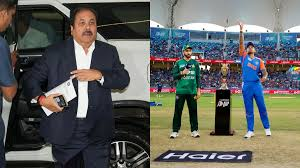

The Board of Control for Cricket in India (BCCI) vice-president Rajeev Shukla on Monday reiterated that the Indian board will strictly adhere to the decision taken by the International Cricket Council (ICC) regarding the uncertainty surrounding the India vs Pakistan clash at the ICC Men’s T20 World Cup 2026.
Speaking to reporters, Shukla said, “I will not comment on all these issues, nor will I make any comment from the BCCI side. Everything has been submitted to the ICC. We will abide by whatever decision or judgment the ICC makes. We have fully entrusted the matter to the ICC.”
Breakthrough Expected After ICC-PCB-BCB Meeting
A resolution to the standoff is expected soon following a high-level meeting between the ICC, the Pakistan Cricket Board (PCB), and the Bangladesh Cricket Board (BCB), according to reports in Pakistan media. Geo TV reported that the PCB is set to consult the Pakistan government for clear guidance on the matter, after which a formal announcement is expected.
An ICC delegation led by Deputy Chairman Imran Khawaja, PCB Chairman Mohsin Naqvi, and BCB President Aminul Islam met in Lahore on Sunday to discuss Pakistan’s decision to boycott the ICC Men’s T20 World Cup 2026 match against India, scheduled for February 15 in Colombo.
Pakistan Government Announces Boycott
Pakistan has officially announced its boycott of the February 15 India match at the ICC Men’s T20 World Cup 2026, with Prime Minister Shehbaz Sharif linking the decision to the Bangladesh issue as a gesture of solidarity.
The situation worsened after Bangladesh were replaced by Scotland in the tournament, following the ICC’s rejection of Bangladesh’s request to play all matches outside India after Mustafizur Rahman’s removal on BCCI instructions.
The International Cricket Council has asked the Pakistan Cricket Board to justify the boycott under ‘Force Majeure’, warning of serious sporting and commercial consequences. The PCB maintains it has a strong legal case, citing a past bilateral dispute with the Board of Control for Cricket in India as precedent.