
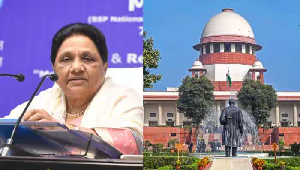

The Supreme Court stayed the University Grants Commission’s Promotion of Equity in Higher Education Institutions Regulations, 2026, calling them “prima facie vague and capable of misuse.” A bench led by CJI Surya Kant and Justice Joymalya Bagchi issued notices to the Centre and UGC, reverting to 2012 rules.
Hearing petitions challenging the rules constitutionality, excluding general category complaints, the Supreme Court questioned safeguards and omissions like ragging. “Are we regressing after 75 years of a casteless society vision?” CJI Surya Kant said. The court also suggested revision by eminent jurists.
The Bahujan Samaj Party (BSP) supremo Mayawati hailed the verdict as “appropriate” amid “social tension” from the rules, urging UGC to consult all castes, including upper castes, for ‘natural justice’.
In a post on social media platform X, BSP supremo Mayawati said, “The new rules implemented by the University Grants Commission (UGC) to prevent casteist incidents in the country’s government and private universities have created an atmosphere of social tension. Keeping in view such current circumstances, the decision today by the Hon’ble Supreme Court to stay the UGC’s new rules is appropriate.”
Mayawati also highlighted that social tensions over the UGC rules could have been entirely avoided had the commission consulted all stakeholders beforehand and ensured fair upper-caste representation on investigation committees, in line with natural justice principles.
“Whereas in the country, an atmosphere of social tension etc. in this matter would not have arisen at all if the UGC had taken all parties into confidence before implementing the new rules and had also given appropriate representation to the upper-caste society in the investigation committee etc. under the principles of natural justice”, added BSP supremo.
The new UGC equity rules mandated equity committees in higher education institutions with Scheduled caste (SC), Scheduled Tribe (ST), Other Backward Class (OBC), Persons with Disabilities (PwDs), and women, representatives for discrimination complaints, stemming from a 2019 PIL by Rohith Vemula and Payal Tadvi’s mothers after their suicides.
The new regulations stemmed from a 2019 Public Interest Litigation (PIL) by Rohith Vemula and Payal Tadvi’s mothers after their suicides. The rules led to backlash, and protests erupted in states over perceived bias against general category students, with critics, including prominent leaders and activists, branding the rules as “anti-general category students,” warning of misuse to target upper-caste pupils and ignite conflicts in educational institutions.