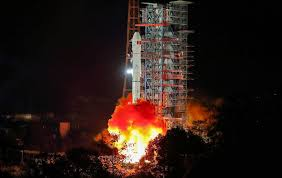

China’s space ambitions faced an unexpected test on January 16, 2026, as two launch missions failed within a span of roughly half a day. The setbacks involved a veteran Long March-3B rocket carrying a classified Shijian satellite and the inaugural flight of Galactic Energy’s new Ceres-2 solid-fuel launcher.
Together, the incidents resulted in the loss of at least seven satellites and raised fresh questions about reliability at a time when China is pushing toward a record-breaking launch year.
Long March-3B Failure Ends Classified Shijian-32 Mission
The first failure unfolded at the Xichang Satellite Launch Center in southwest China. At 11:55 a.m. Eastern Time (1655 UTC), the Long March-3B lifted off as planned, following pre-announced airspace closures. Amateur footage confirmed a clean ascent, yet official silence followed.
Nearly 12 hours later, the China Aerospace Science and Technology Corporation (CASC) acknowledged the failure via a brief statement on WeChat. According to the announcement, a malfunction in the rocket’s third stage caused the loss of the Shijian-32 satellite. State media outlet Xinhua confirmed that an investigation is underway, offering no additional technical details.
A Rare Setback for a Workhorse Rocket
The incident marks the first complete failure of the Long March-3B since April 2020, when a similar third-stage issue destroyed Indonesia’s Palapa-N1 (also known as Nusantara-2) satellite. More broadly, it appears to be the first outright failure across the entire Long March rocket family in nearly 300 launches.
China’s most recent anomaly prior to this occurred in March 2024, when a Long March-2C mission experienced a partial failure involving a Yuanzheng-1S upper stage. The rescue of the DRO-A and DRO-B lunar spacecraft through complex orbital maneuvers and reached their intended destinations.
Why the Long March-3B Matters
The hypergolic-fueled Long March-3B is a cornerstone of China’s geostationary transfer orbit missions. It regularly deploys communications satellites, meteorological payloads, remote sensing platforms, and technology demonstrators.
This failure could ripple across China’s upcoming launch schedule. Missions involving the TJS experimental satellite series and Tianlian data relay spacecraft may face delays. While China can turn to the newer Long March-7A launched from Wenchang, that rocket uses a hydrolox upper stage derived from the 3B—raising the possibility of broader schedule impacts.
Shijian Program Remains Cloaked in Secrecy
CASC provided no insight into Shijian-32’s mission, consistent with the program’s traditionally opaque nature. China uses the Shijian satellites for experimental purposes, including testing new technologies and validating operational concepts in orbit.
In recent years, the program has drawn attention for advanced demonstrations. Shijian-21 and Shijian-25, for example, separated in geosynchronous orbit in late 2025 after spending months docked together—an apparent test of on-orbit refueling capabilities.
Second Blow: Ceres-2 Maiden Flight Fails
Less than 12 hours after the Long March setback, China’s commercial launch sector suffered its own disappointment.
At 11:08 p.m. Eastern Time (0408 UTC on January 17), Galactic Energy attempted the first-ever launch of its Ceres-2 rocket from the Jiuquan Satellite Launch Center in northwest China. The mission followed months of delays and scrubbed launch windows.
Soon after liftoff, the company confirmed that an anomaly had occurred and that the mission was lost. Galactic Energy issued a public apology to its partners, stating that the cause of the failure remains under investigation.
Multiple Satellites Lost on Ceres-2 Debut
Around six satellites were believed to be aboard the Ceres-2 flight. Among them was Lilac-3, an ultra-flat disc-shaped satellite developed jointly by the Harbin Institute of Technology and Beijing University of Aeronautics and Astronautics.
The failure was particularly painful given Ceres-2’s ambitions. The solid-fuel launcher was designed to carry up to 1,600 kilograms to a 500-kilometer low Earth orbit—four times the payload capacity of the smaller Ceres-1 rocket.
A Sharp Contrast to Recent Success
The timing of the failure stung. Just one day earlier, Galactic Energy had successfully returned Ceres-1 to flight with a sea launch from a barge off the coast of Shandong province, rebounding from a November 2025 failure.
Now, the company faces fresh challenges as it seeks to scale up. Galactic Energy is preparing the debut of its Pallas-1 liquid-fueled rocket, capable of lifting roughly 8,000 kilograms to low Earth orbit, and has already filed initial paperwork toward a potential initial public offering.
A Sudden Shift After a Strong 2025
China’s spaceflight record in 2025 was remarkably strong, with just two failures across 92 orbital launch attempts, including multiple successful debut missions. January 2026, however, has already seen two failures within days.
The setbacks mirror challenges faced elsewhere. Earlier this week, India lost its PSLV-C62 mission and 16 satellites due to an anomaly, although Orbital Paradigm later confirmed that its KID reentry capsule survived the incident.
China Still Marching Toward a Record Launch Year
Despite the twin failures, China’s launch cadence remains intense. These were the country’s fifth and sixth launch attempts of 2026, following four successful missions:
- A Long March-6A placing Yaogan-50 (01) into a highly retrograde orbit
- A Long March-8A launching the 18th batch of Guowang satellites
- A Long March-2C carrying Algeria’s AlSat-3A
- A Ceres-1 sea launch deploying Tianqi satellites
Beijing is expected to surpass 100 orbital launches this year for the first time, underscoring the scale of its commercial, scientific, and military ambitions.