
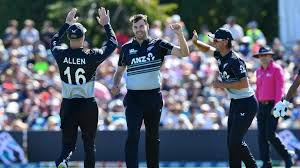

Jacob Duffy’s rapid rise from a value IPL buy to a World Cup debutant has reshaped New Zealand’s T20 World Cup 2026 narrative. The Royal Challengers Bengaluru pacer, snapped up for ₹2 crore at the IPL 2026 auction, has been rewarded with his maiden ICC tournament call-up as the Black Caps unveil a spin-loaded squad built for Indian and Sri Lankan conditions. With Chennai set to host most of New Zealand’s group games, the selection signals clear intent and calculated ambition.
At 31, Jacob Duffy is not a typical first-time World Cup entrant. His inclusion is rooted in sustained excellence rather than sudden hype. Over the past year, the New Zealand pacer has emerged as one of the most consistent white-ball bowlers in international cricket, climbing to No. 2 in the ICC T20I bowling rankings.
RCB’s decision to buy Duffy at his base price of ₹2 crore during the IPL 2026 auction now looks astute. While initially viewed as smart depth acquisition, the signing has gained significance following his World Cup selection. For RCB, it adds credibility to their scouting process. For Duffy, it reinforces his growing stature across formats.
Why New Zealand Have Gone Spin-Heavy for T20 World Cup 2026
New Zealand Cricket has built its T20 World Cup 2026 squad with one clear factor in mind: subcontinental conditions. Three of their four group-stage matches will be played at Chennai’s MA Chidambaram Stadium, historically one of the most spin-friendly venues in world cricket.
Captain Mitchell Santner leads a slow-bowling core that includes Ish Sodhi, New Zealand’s second-highest wicket-taker in T20 internationals. Supporting them are multi-dimensional all-rounders Michael Bracewell, Glenn Phillips, and Rachin Ravindra, giving the Black Caps flexibility to deploy up to five spin options depending on match-ups.
This strategy reflects lessons learned from previous ICC events in India, where adaptability to surface and tempo often outweighs raw pace.
Pace Attack Balances Experience and Form
Despite the emphasis on spin, New Zealand have not compromised on pace quality. Duffy headlines a fast-bowling group that includes Matt Henry, Lockie Ferguson, and Adam Milne, with Kyle Jamieson traveling as cover.
Duffy stands out as the only World Cup debutant among the bowlers, but his recent numbers justify the call. His ability to hit hard lengths, extract movement with the new ball, and execute slower variations at the death aligns well with Indian pitches that reward discipline over express pace.
Coach Rob Walter highlighted adaptability as a core selection principle, stressing the importance of bowlers who can adjust quickly to varying conditions across India and Sri Lanka.
Batting Depth and Subcontinent Familiarity
The batting unit blends power with experience. Finn Allen and Tim Seifert provide aggressive options at the top, while Devon Conway, Daryl Mitchell, and Mark Chapman add stability through the middle order.
Several members of the squad have extensive IPL and subcontinent exposure, a factor New Zealand believe will be decisive in high-pressure situations. Familiarity with venues like Chennai and Ahmedabad reduces the learning curve in a condensed tournament window.
Group D Challenge and Tournament Context
New Zealand begin their T20 World Cup 2026 campaign against Afghanistan, followed by matches against UAE, South Africa, and Canada. Afghanistan’s spin strength and South Africa’s pace-heavy attack present contrasting challenges, making squad balance crucial.
With warm-up games and a white-ball tour of India preceding the tournament, the Black Caps have prioritised preparation over experimentation.
New Zealand Squad for ICC Men’s T20 World Cup 2026
Mitchell Santner (captain), Finn Allen, Michael Bracewell, Mark Chapman, Devon Conway, Jacob Duffy, Lockie Ferguson, Matt Henry, Daryl Mitchell, Adam Milne, James Neesham, Glenn Phillips, Rachin Ravindra, Tim Seifert, Ish Sodhi