
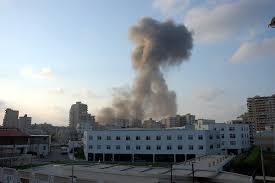

Israel’s intelligence agency, Mossad, has carried out another high-precision operation—this time in Beirut, Lebanon. Israel has been targeting the leadership of groups it considers threats. In its latest strike, Israel eliminated Hezbollah’s top commander in Beirut.
Acting on intelligence provided by Mossad, the Israeli Air Force conducted a targeted airstrike in the Lebanese capital, killing Ali Tabatabai, Hezbollah’s Chief of Staff and a key planner behind several attacks on Israel. The U.S. had placed a $5 million reward on Tabatabai. In today’s DNA episode, Rahul Sinha, Managing Editor of Zee News, analysed Mossad’s strike on Hezbollah commander:
Although Mossad has executed many high-profile operations in the past, the precision of this strike has drawn global attention.
How Mossad Planned the Strike
Video footage from Beirut shows the densely populated neighborhood where Tabatabai was hiding. Narrow streets lined with tall residential buildings made it an extremely difficult location for any direct attack. Israel’s strike is notable because only the specific flat where Tabatabai was present was destroyed, while the rest of the building remained intact—indicating a highly precise operation with no civilian casualties reported in the account.
The Israeli Air Force also released footage showing the moment of impact—fire erupting after the strike and the targeted apartment collapsing.
Tabatabai’s Layered Security
Hezbollah had reportedly created an extensive security system around Tabatabai:
- Multiple layers of security teams surrounded him at all times.
- Signal jammers were installed in advance at any location he visited.
- Several decoy convoys moved ahead and behind his own to create confusion about his movements.
- Areas where he stayed were “phone-free zones,” with no mobile usage allowed.
- His sleeping location changed every night, and he never returned to the same place the next day.
- He held meetings in different buildings daily and had no fixed office.
Mossad’s Use of AI and Field Agents
Mossad’s agents received orders to track Tabatabai, who remained largely invisible to satellites, drones or cameras. To overcome this, Mossad deployed a new AI-based system designed not to track a person directly, but to analyze patterns of human behavior:
- Sudden spikes in electricity usage in an area
- Activation of phone jammers nearby
- Roads are mysteriously cleaned on the same day each week
- Curtains dropping on balconies at unusual hours, such as 2 am.
By piecing together these indicators, the AI system narrowed the target to one of three buildings in southwest Beirut.
Once AI flagged the possibilities, Mossad activated its agents on the ground. One agent observed two guards outside a specific flat—guards known to be closely associated with Tabatabai and only deployed when he was present. Because the building was in a civilian area, Israeli forces could not risk a large strike.
Mossad then used a very small, bird-sized drone to confirm Tabatabai’s presence inside the apartment.

