
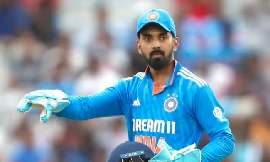

With Shubman Gill ruled out of the upcoming three-match ODI series against South Africa due to a neck injury recovery, KL Rahul once again steps in as India’s interim captain. The series, beginning November 30 in Ranchi, marks another opportunity for Rahul to continue building his identity as a leader in India’s evolving white-ball setup.
A Captaincy Journey Defined by Two Halves
Rahul’s record as India’s ODI captain shows a notable story of progression. Having led India in 12 ODIs, he currently holds a respectable 8-4 win-loss record, translating to a winning percentage of 66.66%. Interestingly, Rahul’s captaincy journey in ODIs began in a challenging fashion. His first assignment, also against South Africa in 2022, ended in a 3-0 defeat. That slow start raised early questions around his decision-making and game management.
However, his response since then has been emphatic.
Over his last nine ODIs as captain, India have won eight, with the only defeat coming against South Africa in the second ODI of the 2023 tour. The turnaround highlights Rahul’s growth in clarity, adaptability, and tactical planning, traits that weren’t as visible when he first took the mantle.
Leadership Impact: Calm, Measured, Evolving
Rahul’s leadership style is notably calm and understated, a contrast to the overt aggression of Virat Kohli or the instinctive flair of MS Dhoni. His decision-making has matured with time, and the settled nature of India’s middle order under him has drawn positive recognition. He appears intentional in his approach: measured field placements, controlled bowling rotations, and a focus on stability rather than impulse-driven changes.
As India enters another ODI series in transition, with injuries, rotations, and grooming of new talent, Rahul’s steady presence may be exactly what’s required.
Batting as Captain: Steady but Lower Than Usual
While leading the side, Rahul has scored 302 runs in 10 innings, averaging 33.55 with four half-centuries, including his highest captaincy score of an unbeaten 58 against Australia in Mohali.
This average is notably lower than his overall ODI batting average of around 48, indicating that the added responsibility of leadership may have influenced his personal output. Still, his consistency in producing starts and stabilising innings demonstrates value beyond raw numbers, particularly in pressure scenarios or when rebuilding after early wickets.
As India prepares for another challenge against South Africa, Rahul stands at a familiar yet defining crossroads.