
On a brisk Wednesday evening in the US capital, President Donald Trump stood before an audience of American and Saudi business leaders and delivered one of his most emphatic promises yet about the future of Washington’s ties with Riyadh. At the US-Saudi Investment Forum, he spoke with unusual ease as he revealed that the United States was preparing to supply Saudi Arabia with what he described as unmatched military hardware.
Usually measured when discussing defence deals on public platforms, Trump leaned into the moment. “…we officially designated the kingdom yesterday as a major non-NATO ally… That is a sign of trust. We signed a historic strategic defence agreement yesterday… We are going to be selling Saudi Arabia some of the greatest military equipment ever built. We build the best military equipment in the world by far. That is why we do the most business, including nearly 300 American-made tanks, which you are buying, many other things, the aeroplanes…” he said, drawing a long applause.
The president tied this accelerated defence cooperation to what he described as a renewed bond between Washington and Riyadh following the US operation that targeted Iran’s nuclear programme earlier this year. He once again invoked that moment with pride.
“The partnership between our two nations is among the most consequential in the entire world, and together the Crown Prince and I are making an alliance stronger and more powerful than ever before… And now it is and probably even better because we took the dark cloud away from your country. It was called Iran and its nuclear capability. We obliterated that very quickly and strongly… But that was a real cloud over the whole Middle East and now they wanna make a deal… We will be doing that probably,” he said.
Speaking in vivid terms about the B-2 bombers that flew undetected, Trump revisited the classified details of the strike, “The B2s were undetectable and they dropped their payload, and every single bomb hit its exact mark, which was a shaft going deep into the mountain… and it was total obliteration… But they want to make a deal. We will see what happens.”
Beyond security cooperation, he highlighted a broad list of economic and technological agreements sealed during this week’s engagements. He called them “groundbreaking” and thanked the Saudi delegation an “extraordinary show of confidence in the American economy”.
“This week, our countries also signed groundbreaking agreements on civil nuclear energy, critical minerals and artificial intelligence… That is in addition to the $600 billion investment in the United States that Saudi Arabia announced during my visit there last spring… Yesterday, the Crown Prince announced that they will be investing in the US is $1 trillion… We are told that $270 billion in agreements and sales are being signed between dozens of companies… On behalf of the thousands of American workers, I want to thank you for bringing all those jobs and great opportunities to our country…,” he said.
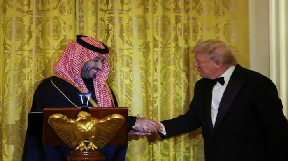
The ceremonial backdrop to these announcements was equally striking. Crown Prince Mohammed bin Salman received a reception at the White House reminiscent of visits reserved for heads of state: the mounted honour guard, the flyover by six military jets and the booming cannon salute on the South Lawn. Trump personally walked him down the newly created “Presidential Walk of Fame” before the two entered the Oval Office.
“We have an extremely respected man in the Oval Office today, and a friend of mine for a long time,” he said as he welcomed the Crown Prince.
The conversation inside the Oval Office touched on one of the Middle East’s most closely watched diplomatic files. The Crown Prince addressed the subject directly, signalling a major shift in Saudi Arabia’s regional posture.
“We want to be part of the accord, but we also want to be sure that we secure a clear path to a two-state solution,” he said, referring to the Abraham Accords that transformed the region’s diplomatic landscape in 2020. “We want them (Israel and Palestine) to coexist peacefully in the region, and we will do our best to reach a deal,” said the Crown Prince.
President Trump then made another statement that is likely to echo through security circles in Tel Aviv, Abu Dhabi and beyond. He declared that the United States was preparing to sell F-35 stealth aircraft to Saudi Arabia, a decision that would give the Kingdom access to the same advanced fighter jet long reserved for Israel.
The approval of the F-35 sale marks a policy departure, as Washington has traditionally ensured that Israel enjoys exclusive access to the region’s most sophisticated American-made systems. While officials insist that the US commitment to Israel’s “qualitative military edge” remains intact, the decision highlights the scale of the new defence partnership Trump hopes to cement with Riyadh.