

The International Olympic Committee (IOC) is reportedly preparing to implement a ban on transgender women competing in female categories, marking a major shift in its gender eligibility policy. The decision follows a detailed scientific review that found lasting physical advantages for athletes born male, even after testosterone suppression.
IOC’s Science-Based Review Prompts Policy Overhaul
According to The Times, the IOC’s medical and scientific director, Dr. Jane Thornton, presented initial findings during a recent meeting in Lausanne. Thornton, a former Olympic rower, outlined evidence showing that biological advantages—such as bone density and muscle mass—remain even after hormone therapy.
A source described the presentation as “scientific, factual, and unemotional,” noting that IOC members responded positively to the data-driven approach.
New Leadership Focused on Protecting Female Category
Under new IOC president Kirsty Coventry, the committee is expected to take a firmer stance on gender eligibility. Coventry, a former Olympic swimmer and multiple gold medallist, has vowed to “safeguard the female category” while ensuring fairness in competition.
Until now, IOC guidelines allowed transgender women to compete if they maintained reduced testosterone levels, leaving implementation to individual sporting bodies. The upcoming rule change would replace that with a unified, binding policy across all Olympic disciplines.
Announcement Expected at 2026 Winter Olympics Session
The new policy is likely to be unveiled early next year, during the IOC session at the Milan-Cortina Winter Olympics in February. Legal experts are reportedly finalizing the framework to ensure the ban withstands potential challenges, as current eligibility rules have only been advisory.
The changes are expected to be fully implemented before the 2028 Los Angeles Olympics, where compliance will be mandatory for all competing nations.
Global Political and Sporting Alignment
The IOC’s decision appears to align with recent political developments, including U.S. President Donald Trump’s executive order banning transgender women from female sports categories. Trump has also stated that the U.S. will deny visas to transgender athletes attempting to compete in Los Angeles 2028.
Several international federations such as World Athletics and World Aquatics have already adopted similar bans for athletes who experienced male puberty. However, others like FIFA have yet to enforce a definitive stance.
Paris 2024 Controversy Sparks Renewed Debate
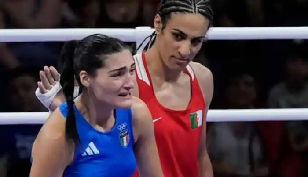
The move follows widespread controversy during the Paris 2024 Olympics, where Algerian boxer Imane Khelif and Taiwan’s Lin Yu-Ting won gold medals despite having been disqualified from the 2023 World Boxing Championships due to gender eligibility issues. The backlash from those events reportedly intensified calls within the IOC to adopt a science-based, uniform global standard.
A Defining Moment for Olympic Sport
If confirmed, this would mark one of the most consequential eligibility reforms in modern Olympic history. The IOC’s upcoming decision aims to strike a balance between inclusion and fairness, potentially reshaping how gender categories are defined and protected in elite sports for years to come.